Nature
 PUBLISHED


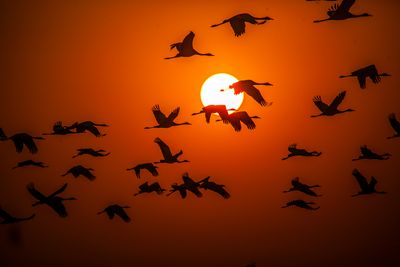


Flocks of birds can be one of the most majestic sights in the natural world, ignoring all the squawks and chaotic flapping. Among certain species, these mesmerizing congregations of flight can reach sizes of unbelievable proportions.
One of the largest recorded flocks of birds featured over 40 million red-winged blackbirds flying over Arkansas in December 1964. This group was observed in Pulaski County by the Arkansas Audubon Society during a Christmas Bird Count and appears to be the largest single flock recorded on eBird, an online database of bird observations used by scientists.
There is another commonly cited report from the winter of 1951-52 that suggests a 70 million-strong flock of Bramblings flew over the Swiss town of Thun. However, modern researchers believe that assessment was based on “questionable methods.”
Likewise, it's uncertain how the report from 1964 in Arkansas was measured. Today, estimates of flock size are made by high-speed cameras and computer analysis, neither of which were available to ornithologists at the time.
When talking about bountiful bird flocks, it’s almost impossible not to mention the red-billed quelea – a notoriously gluttonous bird native to sub-Saharan Africa.
One of the largest flocks of birds ever caught on camera consisted of red-billed quelea swarming over Africa's savannah, filmed in 2006 by a crew for the BBC documentary Planet Earth with David Attenborough.
While Attenborough explains that 1.5 billion members of this species live in Africa – making them the world’s most abundant bird – there was no estimate on the number of birds in this particular mega-flock.
However, there’s good reason to believe they might be a record holder when it comes to flock size. These field-munching flocks are so huge that they can take up to five hours to pass overhead.
.jpg "A flock of red-billed queleas sitting tightly on a small tree in the Kruger National Park in South Africa")
Also known as the red-billed weaver, this is a small sparrow-like bird that’s sometimes known as "Africa's feathered locust" or “Africa's most hated bird” because of their reputation for decimating cereal crops and ability to reproduce rapidly.
"Reducing their numbers is highly problematic - they are highly mobile, have few natural predators and breed extremely fast. Man has been unable to make a serious impact despite the arsenal of weapons available," Clive Elliot, a retired quelea expert at the UN Food and Agriculture Organization (FAO), told the New Humanitarian
"A new population can swiftly move into an area you just killed out ... [and] because they breed three times per year, with an average of three eggs per clutch, one pair of quelea birds can produce up to nine offspring annually," Elliot added.
An unverified account from 1866 says there was a flock of passenger pigeons (aka wild pigeons) that flew through southern Ontario measuring 1.6 kilometers (1 mile) wide and 482 kilometers (300 miles) long. The trailing flock reportedly took 14 hours to pass a single point. If that’s true, it would consist of approximately 3.5 billion birds and could be considered the largest flock of birds ever seen.
Although it’s difficult to assess the veracity of this report given its age and lack of hard evidence, it’s worth mentioning since passenger pigeons are now extinct, despite their once-vast population numbers.
Lastly, if you’re wondering about flightless birds, penguins are the undisputed champion of colossal colonies. Zavodovski Island, an uninhabited volcanic island in the South Atlantic Ocean, is home to more than 1 million breeding Chinstrap penguins, making it the largest penguin colony in the world.
Rest assured though, Chinstrap penguins won’t be flying in flocks any time soon.


 3
3