Nature
 3
3


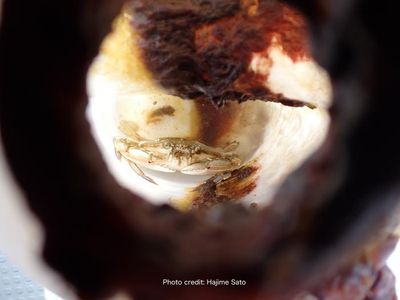


Somehow, this crab managed to slip into a bottle with an opening smaller than its body. What unfolded next was a voyage worthy of its own folk tale.
The epic odyssey was recently chronicled by a team of scientists at Hiroshima University in Japan who were surveying juvenile fish off the coast of Okinawa in July 2022. In the process, they stumbled onto a striking illustration of how plastic pollution is affecting sea life in strange and unexpected ways.
“We happened to encounter a floating plastic bottle approximately 500 meters [1,640 feet] off Sesoko Island, Okinawa, Japan, with many juvenile fish associated with it,” study authors Hajime Sato and Yoichi Sakai said in a statement.
“[To our surprise], a large live swimming crab, Portunus sanguinolentus, was trapped inside the bottle. The crab was clearly larger than the opening of the bottle!”
The mouth of the bottle was just 24 millimeters in diameter, while the crab measured 40.31 millimeters long and 88.23 millimeters wide. Evidently, the crab hadn’t been going hungry while stuck in its bottle prison.
After researchers freed it, DNA analysis of its stomach contents revealed it had recently eaten juvenile fish, including the rough triggerfish, Canthidermis maculata, and the sergeant major, Abudefduf vaigiensis, along with algae that had grown inside the bottle.
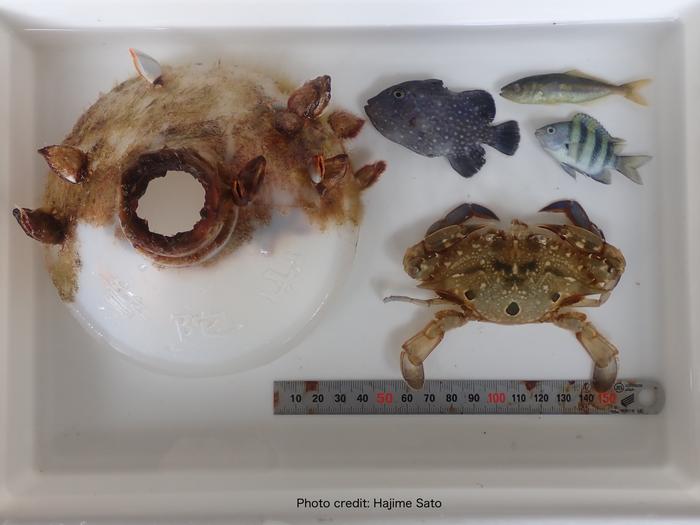
The only explanation was that it had entered the bottle when it was small, young, and naive, then continued to grow until it could no longer exit its home.
To find out how long the crab had been on this claustrophobic cruise, they then looked at the growth rate of the goose barnacle, Lepas anserifera, attached to its surface. Judging by the size of the barnacle and the crab’s growth, they conclude it had been stuck in the bottle for two months.
“This crab reminds us of Salamander, a famous short story by Japanese novelist Masuji Ibuse,” the authors said.
This folk tale, originally published in 1929, depicts the despair of a salamander who is unable to leave his burrow after remaining in his cave and gorging on food for two years. A passage reads: “The salamander felt sad. He had tried to leave the cave that was his home, but his head stuck in the entrance and prevented him from doing so.”
From an ecological point of view, the incident is a vivid example of how plastic pollution is choking the oceans and harming its inhabitants.
“Plastic bottles discarded by humans can trap crabs and prevent their escape. Similar cases have already been reported from waters around Japan, suggesting that this was not an isolated accident. Through this striking example, we would like readers to recognize that objects that make our lives more convenient can sometimes have unexpected effects on small marine animals, while also appreciating the remarkable vitality of the swimming crab,” the authors conclude.
The study is published in the journal Ecosphere.