


 Nature
 PUBLISHED



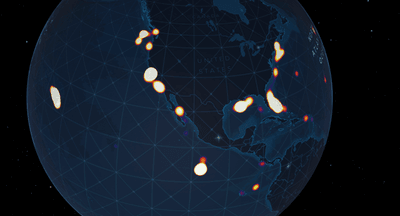


Much of the ocean has never been mapped, and it is for this reason that projects like Seabed 2030 exist, to finally map every ocean. Just over a quarter of the oceans’ floor has been mapped, which is small, but a significant increase from the 6 percent that it was in 2017. Still, there is an even more shocking number: new research suggests 99.999 percent of the deep ocean has never been observed by humans.
The deep ocean is understood as any portion of the Earth's sea that is deeper than 200 meters (656 feet). Those regions cover 66 percent of our planet, and while critical for so many natural processes on Earth, it is the least explored and understood area of our world.
There is a good reason why we haven't mapped the seafloor: it's not worth that much directly, but I think in terms of a common good, it is.
Victor Vescovo
To work out just how unexplored the ocean is, the team looked into the 43,681 recorded submersible expeditions conducted by 14 countries in 120 Economic Zones (EEZs) and the high seas. As far as the data suggests, the team estimates they captured between 2,130 and 3,823 square kilometers (822 to 1,476 square miles) of visual seabed coverage. That is at most 0.001 percent of the total ocean floor, and not even representative since most of the expeditions happened in EEZs within 370 kilometers (230 miles) of the United States, Japan, and New Zealand. Those three countries, with France and Germany, are responsible for over 97 percent of those explorations.
“This small and biased sample is problematic when attempting to characterize, understand, and manage a global ocean,” the authors wrote in the paper.
The team showed that it will need a much bigger effort to see the whole seafloor. The current rate of new observations is 3 square kilometers, just over 1 square mile, per year. Even if there were 1,000 observing platforms, each keeping at the current rate, it would take over 100,000 years to map it all.
“These estimates illustrate that we need a fundamental change in how we explore and study the global deep ocean,” the author write
The deep ocean is important to understand oxygen production on our planet, as well as the climate. Precious molecules collected from deep ocean creatures such as sponges have been used in medicine, and more are likely to come.
There is a precious world down there to study and protect, and that's hard to do if we don't know anything about it. The team highlights that automation might be key to making the goal possible, as it would significantly lower the costs. This is a similar argument to lowering the costs of actually mapping the seafloor in the first place.
“There is a good reason why we haven't mapped the seafloor: it's not worth that much directly, but I think in terms of a common good, it is. From helping with navigation for ships so they don't run into sea mounts or shoals that they don't know about, to mapping the tidal areas and the ocean current areas to help with climate modeling, all of those are common goods that are hard to get funded, but if we make it cheap enough, maybe we are able to make it approachable,” explorer Victor Vescovo, who is developing such approaches, previously told IFLScience.
A paper with the team’s analysis was published in the journal Science Advances.



 1
1