Nature
 PUBLISHED


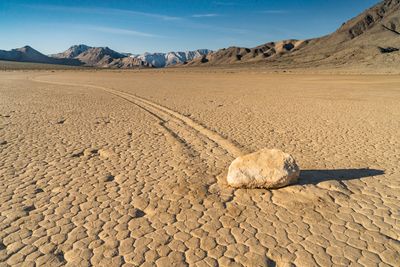


Death Valley National Park, as well as being the hottest place on Earth, is full of curiosities. It hosts spectacular, once-in-a-decade superblooms, ephemeral lakes – oh, and did we mention the stones that seem to move all on their own?
These so-called “sailing stones” can be found on Racetrack Playa, a dry lakebed in a remote part of the park. There are hundreds of them dotted across the landscape, some weighing up to a hefty 320 kilograms (700 pounds). And yet, some have also managed to travel up to 457 meters (1,500 feet), engraving long trails along the surface as they go.
But how? Over the decades, people have proposed all kinds of theories, ranging from strong winds to a rocky slip-n-slide over a film of algae. But no one knew for certain, as the rocks had never been directly observed moving – that is, until 2013.
Two years prior, a team of researchers led by palaeobiologist Richard Norris set up what one of the group, Ralph Lorenz, thought would be “the most boring experiment ever”. With permission from the National Park Service, they fit 15 rocks with motion-activated GPS and set them up on the playa, along with a high-resolution weather station.
They weren’t expecting to see the rocks actually move – after all, they were only the latest in a long string of people to try and figure out the phenomenon, none of whom had witnessed the stones sliding about.
But then, on a visit to the park in December 2013, Richard and his co-author and cousin Jim Norris saw exactly that.
“Science sometimes has an element of luck,” Richard said in a 2014 statement. “We expected to wait five or ten years without anything moving, but only two years into the project, we just happened to be there at the right time to see it happen in person.”
What they discovered was that, in the winter months, the playa can fill up with a shallow level of water. Under freezing overnight conditions, this water transforms into a thin layer of ice – but when the Sun arrives and warms things up, the ice breaks up and floats along the surface, carried along by light winds.
As it does so, it also pushes the playa’s rocks, which mark up the ground below as they move. These movements are relatively small, which could go a long way to explaining why nobody had figured out what was going on until then.
“It’s possible that tourists have actually seen this happening without realizing it,” said Jim. “It is really tough to gauge that a rock is in motion if all the rocks around it are also moving.”
The following year, the team published a study with their findings, and the mystery was officially solved… well, maybe.
“We documented five movement events in the two and a half months the pond existed and some involved hundreds of rocks,” said Richard. “So we have seen that even in Death Valley, famous for its heat, floating ice is a powerful force in rock motion. But we have not seen the really big boys move out there... Does that work the same way?”
That question hasn’t been answered yet, but the team’s findings are still inspiring other work over a decade later, including an experiment to make ice move on its own.
An earlier version of this article was published in February 2025.