Nature
 PUBLISHED



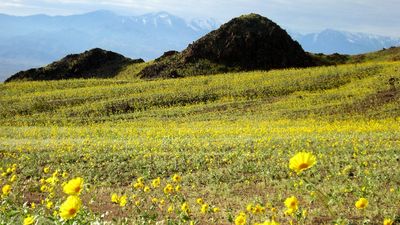


For a place that’s named Death Valley, this scorchingly hot part of California has a surprising amount of life. Never is that clearer than during its rare superblooms, where a vast and dazzlingly colorful array of wildflowers carpets the desert floor. But will we see such an event in 2026?
We call superblooms rare for good reason. On average, they only tend to occur once a decade. According to the National Park Service (NPS) at Death Valley, the last three superblooms in the area happened in 1998, 2005, and 2016 (a pretty spectacular one by all accounts). You might expect, then, that we’re likely to see one this year.
But nature doesn’t always subscribe to statistics – the climate conditions for creating a superbloom have to be, in the words of the NPS, “perfect”. That means a careful combination of three weather-related factors.
The first is rainfall – there needs to be a decent amount of it, but it also needs to be evenly spaced throughout the seasons leading up to summer, when the flowers bloom. Too little rain early on, and the wildflower seeds won’t sprout. A drought later on, and plants that did sprout can’t carry on growing.
Then there’s wind. You don’t want it to be too intense, or especially dry, as that can whip up and dehydrate the delicate young plants. Warmth, on the other hand, is very much a good thing if you’d like a superbloom to happen – and handily, that’s something Death Valley has in spades.
This might all sound like a lot to ask for, but it seems we could be in luck, if recent reports are anything to go by.
“We are expecting a good bloom year. Sprouts have been spotted in many areas of the park, including washes and on hillsides. Low-elevation flowers will likely bloom Feb-March and higher elevations will have blooms April-June,” wrote the NPS in a January 14 update.
In another report on the current wildflower status in Death Valley, David Blacker, the Executive Director of the Death Valley Natural History Association, wrote that the area is “poised for a better-than-average bloom" – but, “with a little luck”, he added, “it could be even better than that.”
The best stretch to be seen in the park at the moment, according to Blacker, is from Mud Canyon to Hells Gate. “Every hillside is covered with greenery,” he wrote. “When this area pops, it will be incredible!”
Death Valley isn’t the only parched place that occasionally erupts into color. Last year, Chile’s Atacama Desert – the driest hot desert on the planet – transformed into a sea of vibrant wildflowers. Like in California, there are normally several years between major blooms there – but the last decade has seen four, with the shortest period between spanning just two years.