Nature
 PUBLISHED




Even in death, whales have a large, looming presence in the ocean ecosystem. After a lifetime of hoovering up marine life, their giant carcasses sink to the seafloor. Here, the decomposing wrecks can remain for years, if not decades, serving as a deep-sea buffet for a host of animals both great and small. For marine biologists, stumbling across a so-called “whale fall” is like striking gold, though the chance to study one comes around once in a blue moon.
The unknown whale found in 2009
With a stroke of luck and an equally strong dose of hard work, scientists at Ocean Networks Canada were given a rare front-row seat to watch exactly this process unfold. In a new study, they report on a whale fall they've been monitoring for 15 years, first detected in 2009, when it had already been lying on the seabed for several years, and since revisited using remotely operated cameras in 2012, 2020, 2023, and 2024.
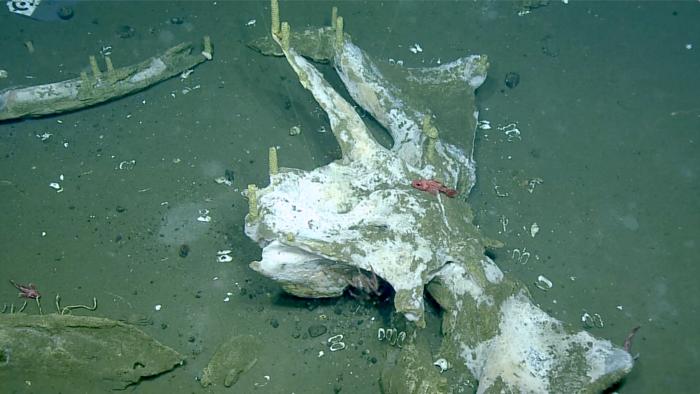
Known as the Clayoquot skeleton, it was located at a depth of 1,288 meters (4,226 feet) off the coast of Vancouver Island in the northeast Pacific Ocean.
The body measures some 16.5 meters (54 feet) from head to tail – that’s a lot of meat, blubber, and other calorific content for the local sea life to consume. Owing to its size and final resting place, it's believed to be a gray whale, although the species is not certain.
Stages of whale decomposition
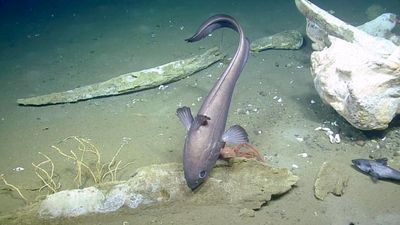
Over the course of the 15 years, the team documented dozens of species at the site, including bone-eating "zombie" worms to clams and snails, all specially adapted to feast on whale falls. Invertebrates dominated the scene, but at least three species of deep-sea fish also made a brief cameo.
The cast of characters changed dramatically over time, cycling through four distinct stages:
- Firstly, sharks, hagfish, crabs, and other mobile scavengers arrive first and strip the flesh from the bones in a chaotic frenzy.
- Secondly, smaller organisms move in – such as worms, crustaceans, and other invertebrates – and feast on the organic material within the bones and other organic detritus that has soaked into the surrounding sediment.
- Third, there’s a “sulphophilic” (sulphur-loving) stage. Tube worms, clams, and sea snails form symbiotic relationships with sulfur-oxidizing bacteria, which together break down the lipids locked inside the bones, releasing sulfur-based chemicals that other specialists consume. This is an especially fascinating stage as it fosters a chemosynthetic ecosystem. Instead of photosynthesis, the foundation of the food web are strange bacteria that convert inorganic compounds into organic matter; no sunlight required.
- In the fourth and final stage, the skeleton effectively becomes the foundation of a reef. Sea corals, sponges, and other reef-dwelling species live upon the bones, and it becomes a permanent structure on the deep-sea floor.
One thread running throughout this process is the presence of sulfur-oxidizing bacteria, which form a white fuzzy coating across the bones. These bacterial mats continued to spread between 2012 and 2023, slowly claiming an ever-greater share of the skeleton’s surface.
The future of whale fall
The researchers estimate the sulphophilic stage had, by 2024, been occurring for more than 21 years and was likely to last at least another decade.
This is relatively long compared to other whale falls that have been studied in the past, and may be partly explained by the site's location on the edge of an Oxygen Minimum Zone (OMZ). Because of these low oxygen levels, certain species are deterred, slowing the overall pace of decomposition.
It's well known that these OMZs, sometimes referred to as “dead zones”, are expanding across the world's oceans due to climate change. As a result, the team suggests that whale falls may continue to lurk around for even longer in the future. This might be good news for opportunistic scientists, but it could have unforeseen consequences in the wider ocean.
“We posit that whale-fall ecosystem function and associated biodiversity may be threatened by widespread expansion of seafloor low oxygen environments on the Cascadia Margin,” the paper concludes.
“In OMZs, whale carcasses may persist longer due to exclusion of scavengers and other whale-consuming fauna [...], as well as from slowed microbial decomposition rates of whale-fall materials[...], increasing long-term carbon sequestration at the seafloor,” it added.
The study is published in the journal Frontiers in Marine Science.

 2
2