Space and Physics


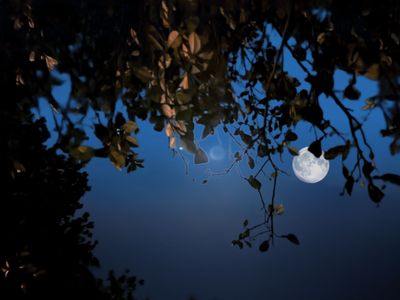


May 2026 is set to deliver a rare celestial double bill: a blue Moon that's also a micromoon. What are the chances, eh? Well, these two events are not super rare by themselves, but together, it's a crossover worth taking note of.
On May 31, there will be a full Moon that qualifies as a “blue Moon” because it's the second full Moon in a calendar month (more on how that occurs below).
It will also be a micromoon, a phenomenon when the moon appears slightly smaller in the night sky than usual.
This isn’t an optical illusion; the moon is literally farther away from planet Earth. It takes place when the Moon reaches full phase while near apogee, the farthest point in its orbit around Earth, making it appear a little more distant and a little more modest than we're used to.
This occurs roughly two to three times a year, but one on May 31 is especially significant as it's set to be the smallest Moon of the year.
As the name suggests, a micromoon is essentially the opposite of a supermoon, when the Moon appears larger because a full Moon coincides with perigee, the closest that the Moon comes to the Earth in its orbit.
What is a blue Moon?
"Once in a blue moon," they say, but that’s actually not too uncommon – Earthlings will witness one roughly every two and a half years (about once in every 30 full Moons).
But don’t expect the lunar surface to glow with a cerulean hue. Blue Moons, in fact, are the name given to a second full Moon that appears within a single calendar month.
The problem is that the solar cycle, which is what our Gregorian Calendar is based on, doesn’t perfectly line up with lunar cycles. The Moon orbits around Earth in 29.5 days, which means we have at least one full Moon every calendar month. This means in one calendar year, it goes around slightly over 12 times.
But as experts among you might have noticed, most calendar months are 30 or 31 days long, with an average of 30.437 days. Since the Moon makes slightly more than 12 orbits each calendar year, every few years we end up with a year that has 13 full Moons. When that happens, one of the 12 months fits in an extra full Moon, typically towards the end of the calendar month.
Why is it called a blue Moon?
As for the name, the color blue has very little to do with it.
According to Royal Museums Greenwich, one theory is that the term “blue moon” is actually a mistranslation of belewe, an old word from Middle English that means “to betray.” So the theory goes, the 13th full Moon in a calendar year is a “betrayer” because it breaks the convention. In an historical context, perhaps the “betrayer” was the Moon itself for deceiving worshippers who relied on it to calculate the timing of Lent.
Another theory links to a 16th-century expression – "the Moon is blue" – used to sardonically describe something impossible or highly implausible.
The Moon can, in very rare circumstances, actually appear blue. For instance, it did this following the cataclysmic eruption of Krakatoa in 1883, when volcanic ash scattered red light and cast a freaky blue tint across the sky.
However, it's safe to say a literal blue Moon only occurs "once in a blue moon."