Space and Physics
 PUBLISHED



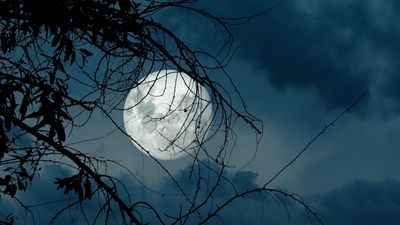


When something happens once in a blue moon, just how often does it happen? Well, usually every couple of years, but thanks to a double definition, until 2028 it will happen yearly. And our next blue moon is just a few weeks away on May 31, 2026, at 08:45 UTC (3:45 EDT).
The Moon doesn't get Smurf-colored during this event. That's because it hasn't got anything to do with the moon actually turning blue. A blue moon is really an extra full moon during a season or month. The term "blue moon" actually comes from a much older expression, and only in the 19th century did it start to refer to a specific astronomical phenomenon.
Astronomy first! The Moon goes around Earth in 29.5 days. That means that in one calendar year, it goes around slightly over 12 times. The slightly over is important. In its cycle, you generally have 12 full moons, one for each month, and you have three full moons each season. But the lunar calendar and the solar calendar don't match exactly, so every few years you end up with a year that has 13 full moons or a season that has four full moons.
Originally, the expression was “the Moon is blue," and it was used in the 16th century to mean something that is impossible. It then moved to mean something rare but not impossible, and a good thing it did, because, in 1883, due to the eruption of Krakatoa, the Moon actually looked blue!
There used to be a specific definition of which full moon was the blue one, but due to an error, it became two. The first definition came from the Maine Farmer's Almanac 1937 edition. This is also where the names of the full moons were codified. Phases and full moons are used a lot in agriculture, and here it was decided that the odd moon out was the third full moon in a season where there are four.
The other popular definition is the second full moon in a calendar month, which you might call the monthly blue moon, and it came from a misunderstanding of the original almanac reference by J.H. Pruitt in a 1946 edition of the American magazine Sky and Telescope. On May 31, 2026, we will have a monthly blue moon. This year has 13 full moons in total.
Next year, we will instead be getting a seasonal blue moon. Again it will be in May, this time the 20th, and it will be the third full moon of spring, even though the year has the regular 12 full moons. Two blue moons in consecutive years isn't super rare. According to Time & Date, between 1550 and 2650, there are 408 seasonal blue moons and 456 monthly blue moons, so either type occurs roughly once every two/three years.
More exciting is 2028. The blue moon of that year will be on December 31, and it will be a supermoon (when the Moon is a little bit closer to Earth, so it appears larger), and it will be a total lunar eclipse, so the moon will turn red at totality. "Super blood blue moon" is a mouthful, so we advocate for calling it the super purple moon.