Nature
 PUBLISHED




The world is buckling up for what could be an especially powerful El Niño, but let’s hope it doesn't match the one seen between May 1997 and June 1998 – the most devastating and costly El Niño event in recorded history.
As early as late 1996, it was already apparent that something strange was stirring. Through a network of moored buoys scattered across the Pacific, meteorologists began picking up on rising ocean temperatures. This is typical of how El Niño announces its return, but the data was particularly unusual.
By February 1997, a patch of warm water stretched across the equatorial Pacific, almost straddling from the coast of Peru to New Guinea, a distance of over 11,000 kilometers (6,835 miles). Come May, it had pushed towards the eastern Pacific, upping temperature anomalies below the surface to more than 6°C (about 11°F) above normal. Eventually, it surfaced, causing sea-surface temperatures in the east to go off the charts. It became starkly clear this was going to be a boisterous El Niño.
Scientists had been keeping a close eye on El Niño using buoys in the sea since the mid-1980s, prompted by the devastating 1982–83 El Niño event, which had gone largely unpredicted. But monitoring efforts truly ramped up in the mid-1990s once the full buoy array was in place. Thanks to these developments, the 1997–98 event has been described as the first El Niño to be scientifically monitored from beginning to end – and what a spectacle it was.
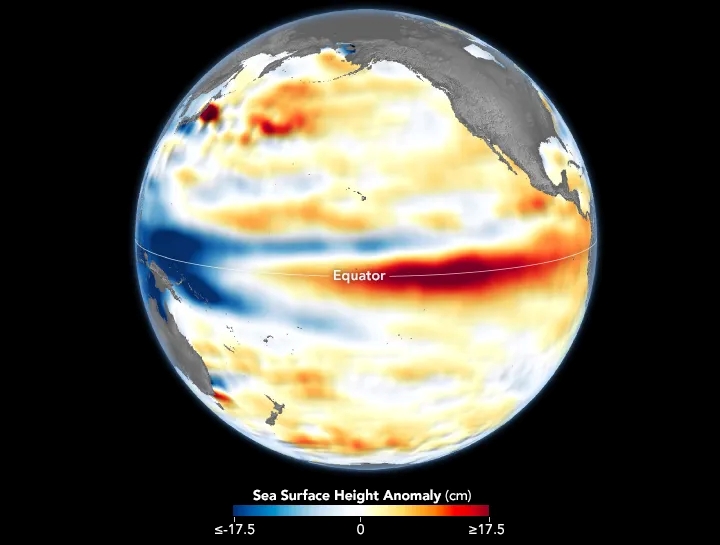
El Niño is a complex climate phenomenon characterized by warmer ocean temperatures and atmospheric pressure across the central and eastern tropical Pacific Ocean. This might sound rather humdrum, but its effect on the weather is bold and felt across the world.
Extreme weather was fueled worldwide
In 1997/98, those impacts were all the more severe. Global temperatures were cranked up, and it was, at that point, the hottest year in recorded history until 2016 (since then, climate change has helped to ensure that record has been smashed time and time again).
For many parts of the world, the increase in temperature caused moisture-soaked air to rise, condense, and fuel wet weather. In the Horn of Africa, floodwaters brought malaria, Rift Valley fever, and cholera in their wake. Latin America saw the same grim pattern with extreme weather introducing a host of water-borne diseases and mosquitoes. Meanwhile, the extra water from El Niño fueled significant disease outbreaks across parts of Papua New Guinea, Indonesia, and the Philippines. In China, Japan, and South Korea, typhoons were rampant throughout the summer months.
In other parts of the planet, it was a lack of water that was the prime. El Niño doesn't magically create water; it displaces it. As a result, some parts see wetter weather, while others have drier conditions.
One of those most impacted by rainlessness was the Amazon Basin, which experienced an exceptionally severe drought, triggering prolonged forest fires and deforestation. Drought conditions were also seen in Indonesia, Malaysia, and the Philippines, after being battered by floods earlier in the year. Over in North Korea, there was a severe outbreak of drought-associated cholera, deepening a horrific famine that had been unfolding since 1994.
The US was not spared from the upset. California and the southern states were rocked by storm after storm, not to mention flooding, while the northern half of the country enjoyed one of its mildest winters on record. Meteorologists in the Midwest called it "the year without a winter" because of the unseasonably balmy weather.
All of this chaos took a massive toll globally. In just over one year, thousands of people died across the world from flooding, drought, famine, fires, extreme heat, and disease outbreaks. There are no definitive statistics on the loss of human life directly attributed to the El Niño of 1997/98 – and it would be very fiddly to calculate them – but a commonly cited figure is 23,000 deaths.
The suffering came in many other forms, too. It’s estimated that poverty rates increase by 15 percent in some of the hardest-hit countries, while costing the global economy $5.7 trillion.
“We’ll see how big it gets”
Whether a future El Niño could rival the 1997-98 season is yet to be seen, but 2026 might give it a run for its money. Over the past few months, several meteorological organizations have said it’s highly likely that El Niño will return by July 2026, with some individuals suggesting a particularly potent one could be brewing.
These predictions, once again, are largely based on what’s going with temperatures and pressure in the equatorial Pacific Ocean. As of mid-May 2026, the situation doesn’t look quite as severe and unusual as it did in early 1997, but the story is still unfolding.
"While this year’s event started a bit later than the big El Niños of 2015 and 1997, it’s beginning to catch up," Josh Willis, a sea level researcher at NASA’s Jet Propulsion Laboratory in Southern California and project scientist for Sentinel-6 Michael Freilich, said in a statement.
"We’ll see how big it gets."