Nature
 PUBLISHED
 3
3


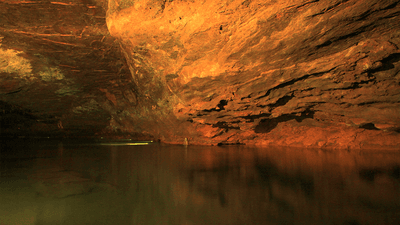


In 1905, a 13-year-old boy was playing in a cave in Craighead Caverns, a giant system of caves in between Sweetwater and Madisonville, Tennessee, as he often did, when he stumbled across an unexplored opening. Having never heard of the Nutty Putty cave incident (largely due to a lack of the Internet and the fact that it happened over a century later), the boy squeezed his way through and made the discovery of a lifetime.
The caves themselves had been known about since the time of the Cherokee, Indigenous people of the Southeastern Woodlands of the United States. Artifacts including pottery, jewelry, arrowheads, and weapons have been found inside a chamber known as "the council room", itself nearly a mile from the cave system's entrance. In the 1800s, colonizers from Europe also found the caves, using the cool environment to store potatoes and other vegetables, while a Confederate soldier left a little graffiti – the number 1863, torched onto a wall, likely in 1863 CE, according to carbon dating.
The cave was also home to a giant Pleistocene jaguar, which made tracks there after likely being lost there some 20,000 years ago, before falling and dying in a crevice as it tried to escape the darkness.
As far as we know, the "lost sea" beneath the cave was not discovered until that 13-year-old boy crawled through a hole in the wall, against all possible spelunking advice.
"The lake was discovered by Ben Sands," Craighead Caverns tour guide Savannah Dalton explained to CBS News in 2019. "A 13-year-old boy who had actually crawled through a tunnel that was the size of a bicycle tire for 40 feet before he dropped down into the lake itself and actually waded out into about knee-deep water. It was a lot smaller when he came through. But we've blasted it out since."
Sands found himself inside a gigantic room half-filled with water, with a torch not powerful enough to see the other side. In the room, which had perhaps never been seen by human eyes before, he began throwing mudballs in every direction he could, attempting to figure out how large the area was, but heard nothing but the splash as they fell into the water.
The Lost Sea is also home to some interesting geological features. Anthodites – also known as "cave flowers" – are rare formations, found only in a handful of caves in the US.
“[Anthodites are] formed from water that seeps through the rock and is mixed with aragonite crystals and calcite,” Lisa McLung, general manager of The Lost Sea Adventure, told The Appalachian Voice. “We call them flowers because they’re spiky and they can form in different colors, depending on what minerals are coming through the rock in that particular area.”
The area where Sands first fell into is now home to around 300 rainbow trout. These animals were not native to the cave, and hadn't survived cut off from the rest of the world, but were introduced after the cave's discovery. The hope was that by putting the trout into the lake, they might escape and reveal entrances to other areas of the lake. With no food supply, they learned to wait for their food from boatmen arriving with some of the 150,000 tourists a year who chose to visit the cave.
"They're down here long enough that they do lose a small portion of both their eyesight and their color," Dalton added. "The lighting of course is not natural sunlight, so they can't really maintain that pigment."
That part of the lake has now been explored a little better, and we now know it is around 243 meters (800 feet) long by 67 meters (220 feet) wide. But that is only the part of the lake that we can see.
Underwater, the lake leads off to other halls. Divers have explored some other areas of the lake and mapped over 5.2 hectares (13 acres) of water, but still have not found the lake's end. In fact, the National Natural Landmark is thought to be the largest underground lake in North America.