Nature
 PUBLISHED
 1
1


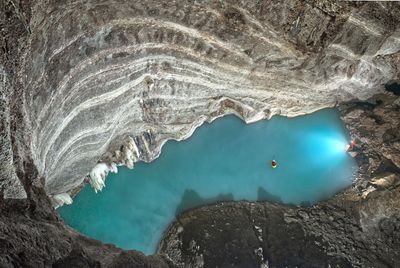


Four years after it was first discovered, a team of Czech scientists have finally confirmed that they’ve found the world’s largest underground thermal lake.
Nestled within the limestone of Vromoner in southern Albania, the body of water – now named Lake Neuron, after the foundation that sponsored the team – was uncovered during a geological research expedition in 2021.
The team first noticed a high column of steam. That steam, they found out, was emerging from an abyss over 100 meters (330 feet) deep, at the bottom of which they “discovered a strong thermal inflow and a vast lake,” said Marek Audy, the head of the recent expedition, in a translated statement.

As with any scientific discovery, Audy explained that “it was necessary to conduct scientific research and precise measurements” in order to demonstrate to a wider audience what they had found – what appeared to be the world’s largest underground thermal lake.
“During our initial exploration, we created a basic map using our equipment and immediately realized that we had discovered something extraordinary,” photographer and expedition participant Richard Bouda told Euronews Albania.
But this wasn’t enough for a proper confirmation, and at the time, they didn’t have the right equipment to provide the level of detail required. Audy explained to National Geographic CZ that when they used a laser rangefinder to map the cave and lake, “it reported an error because the rangefinder has a maximum distance of 100 meters [328 feet].”
Then, thanks to funding from the Neuron Foundation, a team was able to return to the lake with new technology in hand. This included a mobile LIDAR scanner, enabling them to produce a detailed 3D map of the underground cave – dubbed Atmos – and Lake Neuron.
Measurements with the scanner confirmed that it is indeed the world’s largest underground thermal lake, revealing it to be 138.3 meters (452.8 feet) long and 42 meters (137.8 feet) wide, with a perimeter of 345 meters (1,131.9 feet).
It holds 8,355 cubic meters (295,054 cubic feet) of water – that’s the equivalent of around 3.3 Olympic-sized swimming pools, or enough to fill up your 40-ounce Stanley cup 6,962,500 times, not that we’d recommend swimming in or drinking underground cave water before we know what’s in it.
On that point, the expedition team hopes to return to the Atmos cave and Lake Neuron once again to discover the details beyond its size alone.
"We want to look at other parts of the cave, learn more about the geology and biology of this area," Audy told National Geographic CZ. "It's something that could have a huge impact on understanding underground ecosystems and geological processes.”