Nature
 PUBLISHED


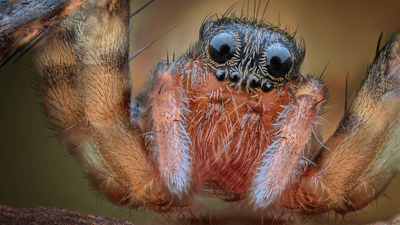


Arachnophobia is among the most common phobias, affecting millions worldwide. It might cause a person to scream and jump upon seeing a spider – something a recent video suggests could result in the spider doing the same.
The adorable clip shared to Instagram by adventure traveler Tanin Kayvan shows a spider walking along the floor of the room. A voice says “boo,” causing the spider to, well, freak out.
The spider scrabbles and flips before righting itself. It really looks like it got a fright, or to borrow the ingenious words of one user’s comment: “His heebies were in fact, jeebied.”
It raises two interesting questions: Can spiders hear? And do they get scared?
If we define scared as reacting in response to a threat, then the evidence suggests a resounding yes. I’ll say it louder for the arachnophobes in the back, but there’s plenty to suggest spiders really may be more scared of us than we are of them.
A common reaction to a perceived threat among spiders is to play dead. A 2023 study found that Jorō spiders can be particularly dramatic in the charade, with one spider playing dead for over an hour after being threatened with a turkey baster. It’s pretty easy to tell when a spider is playing dead because of the distinctive posture they adopt.
Spiders don’t have blood. Their bodies are filled with a fluid called hemolymph, and it’s pressurized in a way that keeps their limbs spread outwards. That’s why when you find a dead spider, its legs are bent and curled inwards – there’s no hemolymph being pushed into the legs to keep them straight. That loss of stability also changes the spider’s center of gravity, which is why dead spiders are almost always on their backs.
So, could this spider be attempting to play dead? If flipping onto its back like that was on purpose then maybe, temporarily, but then it keeps skedaddling. This movement more closely resembles something scientists observed in a study of jumping spiders.
Before we get into what they saw, some context: spiders can hear. They don’t have ears or eardrums, but they live in a world of vibrations, and they’ve adapted to detect those vibrations in numerous ways. Hairy legs are thought to play a role in hearing for species like the ogre-faced spider, while others may listen with their webs.
To test the hearing capacity of jumping spiders, researchers placed them inside special boxes designed to eliminate vibrations from below. They then produced a buzzing sound to see if and how they reacted.
They showed no reaction to a silent control and high-frequency buzzes, but when the buzz was within 80 hertz, they exhibited what the researchers called an "acoustic startle response". The spiders froze and looked around, and their brains showed a spike in activity.
This is interesting because it overlaps with the sound produced by one of their fiercest predators, the mud dauber wasps. The spiders were also able to detect the sound from distances of over 3 meters (9.8 feet), which is around 350 times their body length.
This kind of acoustic startle response is what you'd expect to see in response to a predator in the wild, and one that can apparently be elicited by saying "boo" in a quiet room.

 1
1