Nature
 PUBLISHED


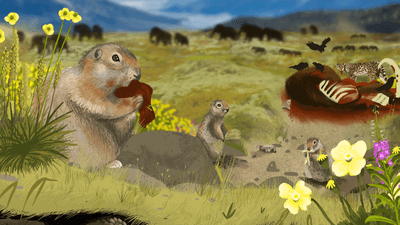


Nuts. That’s what you imagine when you think of a squirrel’s diet. Perhaps a few seeds. We don’t tend to associate these animals with meat-eating, but a staggering time capsule of ecological data has just revealed that, in fact, squirrels have been feasting like zombies for hundreds of thousands of years.
That time capsule was made up of coprolites, AKA fossilized poo. It’s rare we’re able to yield much in the way of DNA from coprolites, but the burrowing behavior of ground squirrels means their droppings are uniquely well preserved. They would have spent many months within these burrows going without food, so when it was time to go surface-side they were hungry – and hoo boy, did they eat.
A time capsule in the permafrost
The ancient ground squirrel burrows had been locked in permafrost for thousands of years, but they were uncovered when goldmining in the Klondike region of Canada’s Yukon territory blasted it away using water jets.
DNA analyses of the droppings they contained, which date back between 700,000 and 17,000 years, have revealed a snapshot of the bustling Pleistocene ecosystem.
Evidence of diverse plant species, insects, and even megafauna such as woolly mammoths, bison, and big cats suggest that nothing was off the menu when the time came for these squirrels to emerge from their burrows.
Ground squirrels belong to the genus Urocitellus, which contains 13 species. They like to nap and can spend up to eight months of the year in their burrows in a hibernation-like state known as torpor. It means going without food for a long time, so they aren’t fussy when it’s finally time to eat again.
Today squirrels are known to eat roadkill, including the remains of their own species, and there are even squirrels in California that have been filmed hunting and killing other mammals. Squirrels are more bloodthirsty than many of us realize, then, but their omnivorous diets also make their droppings a great way to study past environments.
Squirrel coprolites: A treasure trove of ancient DNA
Using shotgun metagenomics, scientists were able to sample the coprolites and reveal mitochondrial DNA sequences of an entire cast of Ice Age lifeforms.
They included parasitic worms, plants, bats, birds, woolly mammoths, bison, and a big cat that may have been the North American cheetah or puma – quarry a squirrel couldn’t ever hope to hunt, but food they clearly didn’t turn their nose up at.
“You can imagine these squirrels emerging from the ground, starting to eat carcasses lying in the environment,” said Mikkel Pedersen, a molecular palaeoecologist at the University of Copenhagen who peer-reviewed the research, to Nature News. “They’re zombies of the Pleistocene.”
The coprolites were aged using volcanic ash deposits on their surface, suggesting the oldest are around 700,000 years old. If accurate, that would make the reconstructed DNA sequences of mammoths among the oldest on record for any organism.
The research highlights fossilized squirrel burrows and their associated coprolites as an untapped resource for studying ancient palaeoenvironments. It’s also a reminder to not sunbathe too lifelessly if you’re in ground squirrel territory.
The study is published in Nature Communications.