Humans
 PUBLISHED
 1
1


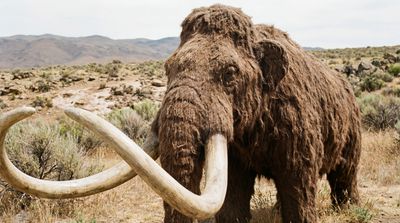


Between about 29,000 and 25,000 years ago, western and central Europe were virtually devoid of human life as the region fell into icy grip of the Last Glacial Maximum (LGM). Surprisingly, however, researchers have just discovered the butchered remains of a woolly mammoth in southeastern Germany that dates to exactly this period, raising question marks over who killed the beast.
To make matters even more mysterious, no other signs of human activity or occupation have been found anywhere near the ancient skeleton. No tools, no cultural artifacts, and no settlements were identified by the researchers, who are unable to explain what happened to the mammoth or its butchers.
Discovered in the village of Taimering in Bavaria, the large sub-adult mammoth skeleton consists of 72 bones and one tusk measuring 2.45 meters (8 feet). On the animal’s ribs, researchers noticed a series of cut marks that are unmistakably associated with butchery using a stone blade.
One of the ribs even appears to have been used as a chopping board, upon which other items were cut.
Radiocarbon dating indicates that the mammoth died between 26,900 and 25,300 years ago, which corresponds to the Late Gravettian. This period saw the onset of the LGM, and is associated with a massive population decline among Europe’s human inhabitants.
As the big freeze spread across the landscape, a demographic collapse occurred in all areas of the continent except for the areas that are now Portugal and eastern Romania. In Germany and the surrounding countries, all previously established human populations vanished from the archaeological record about 29,000 years ago.
“At the same time, the median of the estimated absolute number of people living in the remaining settled regions in Western and Central Europe dropped to only about one third from 2,800 to 1,000, probably bringing the meta-population close to the threshold of a minimal viable population,” write the study authors.
With humans on the verge of extinction in Europe and entirely absent from Germany, then, it seems very odd that someone should have butchered a mammoth in Taimering during the Late Gravettian. According to the study authors, whoever preyed upon the animal must have been amongst the very last people to foray into Bavaria before the LGM put a complete stop to all human activity in the area.
They go on to speculate that these Late Gravettian hunter-gatherers may have come from the east, as mammoth hunting was more common there than it was in western Europe. However, in the absence of any tools or cultural artifacts associated with these Ice Age butchers, it’s impossible to say very much about who they were or where they came from.
The researchers are also unable to discern how the mammoth died, and whether it was actively hunted by humans or simply scavenged upon after meeting its end in some other way. “We cannot say whether it was killed by humans or was already dead when humans processed the carcass,” they write.
With no further clues as to how these remarkable events unfolded, the case remains cold. For now, all that the authors are able to deduce from the scene is that “the documented human activities likely represent one of the last excursions from late Gravettian hunter-gatherers into Bavaria before the hiatus of the LGM.”
The study is published in the Journal of Archaeological Science: Reports.