Nature
 PUBLISHED
 38
38


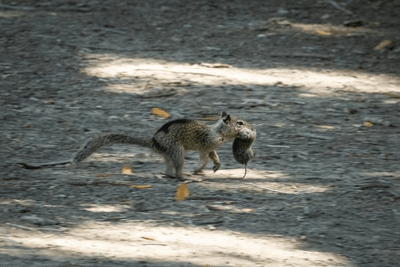


Squirrels are famous for loving nuts, so all that digging, climbing, and dramatic nut dropping seems to make sense. But in California, they appear to have picked up a darker habit. Research from 2024 offers the first evidence that California ground squirrels can act as predators and meat eaters, with cameras capturing them hunting, killing, and eating voles.
"Granivorous" is the term for animals that subsist on grain, surprise surprise. A name that was previously relevant to the California ground squirrel, Otospermophilus beecheyi, but that seems to have changed.
The Long-term Behavioral Ecology of California Ground Squirrels Project has been conducting observational studies in Briones Regional Park in Contra Costa County for 12 years – but in 2024, they spotted something shocking. The ground squirrels share this habitat with voles, and in the 74 interactions observed between the two species, 42 percent involved the squirrels actively hunting the voles.
In case you’re hoping, “Perhaps they were just playing? Squirrels love to run.” we're afraid to tell you that no, there really is no misinterpreting this behavior. Nothing drives home the message that something eats meat quite like watching it casually munch on a headless corpse.
Predatory ground squirrels were something that nobody on the team had witnessed before, so it must have been confusing for the first people to spot the behavior – a group of undergraduates – when they asked project co-lead Sonja Wild of UC Davis for clarification on what they'd seen only to be told “I’m not sure what you’re referring to." Then, they showed her the video.
“I could barely believe my eyes,” Wild, a postdoctoral research fellow in the UC Davis Environmental Science and Policy department, said in a statement. “From then, we saw that behavior almost every day. Once we started looking, we saw it everywhere.”
Hunting, killing, and eating voles was seen being practiced by squirrels of all ages and sexes between June 10 and July 30, 2024. It seemed the feasting festival really kicked off around the same time there was an explosion in vole numbers in the park, suggesting that it may be a response to the sudden uptick of delicious voles.
“This was shocking,” said lead author Jennifer E. Smith, an associate professor of biology at UW-Eau Claire. “We had never seen this behavior before.”
“Squirrels are one of the most familiar animals to people. We see them right outside our windows; we interact with them regularly. Yet here’s this never-before-encountered-in-science behavior that sheds light on the fact that there’s so much more to learn about the natural history of the world around us.”
A shocking turn of events for human scientists, but this kind of flexibility when it comes to dietary preferences may benefit the squirrels in navigating rapid changes in their habitat caused by human activity. Like raccoons and coyotes, they’re known to be incredible opportunists, but it’s not such good news when the opportunity they’re seizing happens to be your head. Sorry, voles.
The study was published in the Journal Of Ethology.
An earlier version of this article first appeared in 2024.