Space and Physics
 PUBLISHED


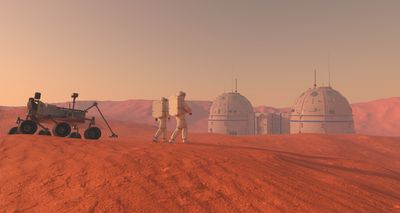


Humans have long dreamed of living beyond planet Earth, but are we truly ready for the journey? Even if we overcome the immense engineering and technological hurdles, settling the Solar System and beyond could bring irreversible changes to humankind. And we’re not just talking about mind-bending shifts in culture, society, and politics, but potentially profound alterations to our biology itself.
These ideas are at the heart of Scott Solomon's new book, Becoming Martian: How Living in Space Will Change Our Bodies and Minds. Solomon, an evolutionary biologist at Rice University, has spent years investigating what space settlement would mean not just for civilisation, but for the human organism. IFLScience previously spoke to Solomon in 2024, but with the brilliant book now on the shelves, we thought it was worth digging a little deeper into his brain.
Solomon's central thesis is both fascinating and a tad unsettling: over millions of years of natural selection, Homo sapiens have been carefully molded for life on this planet. Our bodies and brains are finely tuned to its atmosphere, gravity, radiation environment, microbes, and rhythms of light and dark. Everything from the density of our bones to our circadian clocks is a reflection of this long evolutionary journey on this world. Step off that world permanently, and we’d be launched along a very different evolutionary path.
Animals on islands – and I argue planets are basically just giant islands in the sky – they often get bigger or smaller over evolutionary time. There's a possibility that could happen to us.
Scott Solomon
Mars is often cited as the prime target for space settlement, but Solomon argues that his conclusion will be applicable to anywhere human populations live for long periods beyond Earth, whether it's a Manhattan-sized space station, the Moon, or a distant exosystem.
Settlers on the Red Planet would face a gravitational pull just 38 percent of Earth's, elevated radiation exposure, and an almost total absence of the microbial ecosystems that have shaped our immune systems since before we were human. In the short term, these conditions are merely challenging. Over generations, Solomon argues, they could become transformative.
“Animals on islands – and I argue planets are basically just giant islands in the sky – they often get bigger or smaller over evolutionary time. There's a possibility that could happen to us,” Solomon told IFLScience
“In a space settlement, it's likely that resources are going to be somewhat limited and a smaller-bodied individual requires fewer resources, less water, less food, less air, and less space, so there could be an advantage to being a bit smaller, especially in the first years of a settlement,” he added.
Living in lower gravity would present serious physiological challenges. For instance, experiments aboard the International Space Station have shown that microgravity leads to bone density loss and muscle atrophy. It remains unclear exactly how this would play out on Mars, where gravity is roughly one-third of Earth's, but the likely result is a population with weaker bones and diminished muscle mass.
Solomon argues this could be especially damaging for children, whose bodies are still developing. “It could be much worse because if you're building your skeleton and your muscles in that lower gravity environment, there's a possibility that it just wouldn't form in the proper way,” he notes.
He also flags childbirth as a serious concern. It already carries significant risks here on Earth, but compounded by a weakened skeleton and an alien environment, the dangers to both mother and child could multiply considerably. As a result, Solomon believes most births in a Martian settlement would need to be delivered by Caesarean section – and that shift could literally reshape the human species over time.
“It sets up an interesting scenario where if all births are C-section births, then the head is no longer constrained by having to fit through the birth canal, which has been a constraint throughout human evolution. As our ancestors evolved, our brains got bigger and our heads got bigger, but then there was an upper limit on how big they could get because you still had to fit the head through the birth canal. If that's not the case anymore, heads can evolve to become larger,” Solomon explained.
Beyond anatomical differences, we can also see visible changes in our skin. The pigment in our skin, melanin, serves as a vital shield, absorbing harmful UV radiation to shield skin cell DNA from damage. Mars has a much higher radiation environment than Earth since there's no magnetic field and the atmosphere is extremely thin. Unless colonists live entirely underground with simulated sunlight, it’s not impossible that our skin pigments might change to accommodate this new radiation exposure.
That could be the showstopper, basically. Like all of the whole concept that we could live in space is dependent on that [reproduction] working and we don't know if it works.
Scott Solomon
“One scenario is that pigments evolve to make us darker or new pigments come into existence, which change skin color. If you want to think about ways in which we might look like science fiction aliens, there are some plausible scenarios,” he told IFLScience.
In sum, the human population on Mars might eventually evolve into large-headed, slight-bodied people with otherworldly skin pigmentation. It’s not quite little green men, but it does sound oddly familiar.
However, all of this dreaming hinges on one big unknown: can humans have sex and reproduce in space? As far as we know, no one has ever had sex in space. There have been plenty of rumours over the years, but none have ever been confirmed. The logistical challenges of microgravity aside, the deeper concern is what happens if fertilisation does occur. Whether the extraordinary stresses of a space environment could give rise to developmental abnormalities in human offspring is a question science has yet to answer.
“That could be the showstopper, basically. Like all of the whole concept that we could live in space is dependent on that [reproduction] working and we don't know if it works,” Solomon notes.
“That's another of the reasons I'm saying ‘we're not ready.’ We can't move forward with plans to build a self-sustaining or self-growing city in space if we don't even know that it can be self-growing,” he added.
Perhaps the most overlooked threat, Solomon argues, is microbial. Astronauts in space experience a partially compromised immune system. Simultaneously, the bacteria traveling with them will evolve, becoming better adapted to infecting hosts in this alien environment.
That combination alone is worrying. But the deeper concern is for children born off-world, who would develop their immune systems in near-total microbial isolation, exposed to only a tiny fraction of the diversity they'd naturally encounter on Earth. Return trips could make them genuinely ill – it would be like the diseases of the Colombian Exchange on cocaine.
It's a challenge Solomon feels has been underestimated, one that could ultimately determine whether humanity can move freely between planets at all.
For all these reasons, and more, Solomon believes humanity is nowhere near ready for space settlement – that’s worth keeping in mind the next time you hear an overconfident space billionaire talking about building a self-sustaining city on Mars within a few years.
“I'm not saying we should never go. In fact, I think that there are good reasons to try, eventually,” Solomon concluded, “but I don't think we're ready.”