


 Health and Medicine
 PUBLISHED





When we think of viruses, we mainly think of human diseases, particularly those that are difficult to deal with. However, there is a class of viruses known as bacteriophages that do not infect humans but bacteria. Understanding those interactions matters a lot in health and medicine, and it turns out that studying them in space might have opened a whole new frontier in fighting microbial infections.
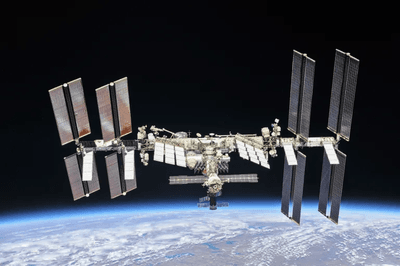
Recent and even not-so-recent findings have shown that bacteria go weird in microgravity. Bacteria have been found on the International Space Station (ISS) that have evolved to be different from any other earthly counterpart. They also create biofilms that make them more difficult to fight. This could be a serious problem when it comes to tackling pathogens in the environment, but given the presence of so many bacteria inside of us, researchers started to wonder how that affects humans in space.
“What really got us thinking about the space experiments was long-term space travel, to Mars and other places,” lead author Vatsan Raman, assistant professor at the University of Wisconsin-Madison, told IFLScience. “How would the microbiome change if we were to travel long distances in space for weeks or months on end? That was an intriguing question. How things sort of churn and mix in microgravity.”
The message is that there are mutations that these bacteriophages can acquire which will make it beneficial for us to use them against pathogens.
Vatsan Raman
The team could not reproduce the whole human microbiome. Space for experiments is very limited on the ISS, so they instead created a small experiment featuring E.coli and a bacteriophage known as T7; both are commonly found in the human digestive tract. Two copies were made, with one sent up into space and the other kept on Earth as a control. Stark differences were seen between the two, which the team summarized in four observations.
“We found that typically on Earth, the bacteriophage infection happens in about 20 minutes,” Raman told IFLScience. “In the International Space Station, this infection took hours to days to complete; so the infection dynamics were very, very different.”
That was the first finding of the study. The second was that the bacteria had acquired mutations while being in microgravity, something that has also been seen in previous experiments. The third observation was that the bacteriophage also acquired mutations, which eventually allowed T7 to infect E. coli.
“The fourth observation, which is very serendipitous and kind of compelling, was that we took those mutant bacteriophages that we identified from the International Space Station and we applied them to pathogens on Earth. These are bacteria that cause urinary tract infections [UTIs]. These mutant bacteriophages were very effective at killing these pathogenic bacteria that cause urinary tract infection, which was quite surprising, but it worked,” Raman explained.
We've barely scratched the surface with this very simple experiment. This really opens more questions than answers in some ways.
Vatsan Raman
The E. coli that cause UTIs are normally resistant to T7; a modified T7 based on the version that traveled to space was able to kill those bacteria. Bacteriophages have been seen as a possible solution to the increasing problem of antibiotic-resistant bacteria. This experiment suggests that it is possible to make even more effective viruses that kill off bacteria.
“The message is that there are mutations that these bacteriophages can acquire which will make it beneficial for us to use them against pathogens,” Raman told IFLScience.
A space experiment benefitting life on Earth is nothing new, but it is always wonderful to see how something as simple as a bacteria-virus interaction that is happening in your gut right now might provide a revolutionary weapon in the medical arsenal. And with an eye to space, this work shows how little we know of the changes that microgravity produces in living organisms.
“Space travel is very exciting! We've barely scratched the surface with this very simple experiment,” Raman told IFLScience. “This really opens more questions than answers in some ways. I think what would be really cool is sort of constructing more complex microbes and microbial communities that represent the complexity that we have in us, and running these experiments. International Space Station. So, to ask: how does the microbiome change for long-term space travel?”
The study is published in the journal PLOS Biology.


 10
10