Nature
 PUBLISHED


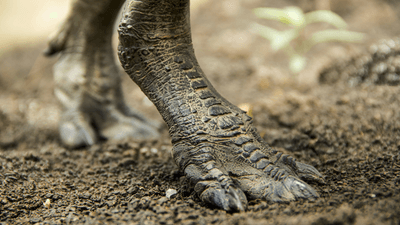


Regrettably, we’ll never get to de-extinct a Tyrannosaurus rex like Jurassic Park and, as such, we have to rely on the fossil record for clues about their behavior. Many people have wondered about how they really moved. Were they fast? Slow? Did they step like a human with their whole foot, or stick to just their tippytoes like big birds?
Now, a first-of-its-kind quantitative analysis has investigated if foot strike patterns can indicate gait style. Ian Malcolm gazed into a quivering puddle in the shape of a T. rex footprint, so what can that shape tell us about how they moved?
The study took a multi-pronged approach, looking at four well-preserved T. rex skeletons and modeling foot strike effects based on different movement patterns. The authors then compared these findings against those of living animals like humans, ostriches, and several other birds.
They also looked at the dimensions of footprint fossils attributed to T. rex, an area of science known as ichnology (and turns out, there’s an app for that). Together, this information enabled them to estimate how fast T. rex could move, and how it was moving.
The results suggest that rather than stomping its big feet down flat like a human, T. rex would’ve pursued prey on its tiptoes. This mirrors the locomotion style of ostriches alive today. Not all that surprising, given birds are dinosaurs, but it’s a rather terrifying prospect to anyone who’s ever had to round up chickens.
"Our study represents, to our knowledge, the first quantitative biomechanical analysis of the effects of foot-strike patterns on the gait of Tyrannosaurus," concluded the authors. "We find that the pes [terminal hindlimb segment] of T. rex functioned similarly to the foot of a bird."
"This includes the adoption of bird-like characteristics in the gait of T. rex, including higher stride frequencies, proportionally short [stride lengths] and moderately elevated top speeds. This kind of locomotion would represent a significant shift in our understanding of how T. rex moved."
The speed at which they were moving likely depended on their size. Youngsters would’ve been faster, with top speeds around 11 meters per second (36 feet per second), while behemoths like Sue the T. rex (whose skeleton was included in the study) could’ve been closer to 5 meters per second (16 feet per second). It’s likely, then, that the available menu items changed throughout their lives (how long did dinosaurs live?).
So, some fresh inspiration for anyone planning the next big dino flick, and another piece of evidence that T. rex and other theropod dinosaurs already had bird-like traits long before modern birds evolved. Speaking of, did you hear about the wacky thing scientists recently found inside Archaeopteryx’s skull?
The study is published in Royal Society Open Science.

 1
1