Nature
 PUBLISHED
 2
2


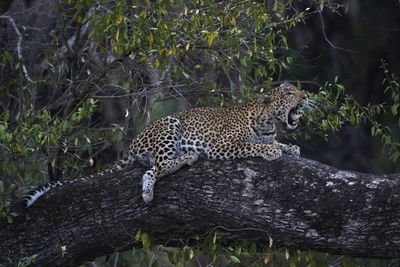


Identifying individuals of wild, free-roaming animals is a tricky and time-consuming task. Visually confirming this is also more difficult for species that live elusive lives, such as solitary big cats, or that might be nocturnal, or live in hard-to-reach areas. Given the need to protect and conserve species such as leopards, scientists have come up with a cheaper and highly accurate way to identify leopards using their vocalizations.
In the Nyerere National Park, southern Tanzania, 64 camera trap stations were deployed to capture images of leopards within the park. In addition to the camera traps, at 50 of the stations, autonomous recording units (CARACALs) were also installed, each containing four microphones to record the vocalizations of the leopards. Recordings were made between September 20 and November 20, 2023.

The team looked at the photographs the camera traps had taken first, to identify individual leopards. Once that was established, they moved on to listening to the audio files recorded at the same time as the photographs.
Leopards have surprisingly distinctive calls, known as a “sawing roar”. The team were able to identify that the leopard roars consisted of three stages, including an initial part and an ending part known as “ruffs”. The team included the data in their analysis when a leopard roared within 10 minutes of being photographed.
“Discovering that leopards have unique roars is an important but fundamentally quite basic finding that shows how little we know about leopards, and large carnivores in general," said lead author Jonathan Growcott, a PhD student at the University of Exeter, in a statement sent to IFLScience.
In total the team were able to identify 42 different individual leopards from over 191 photographs of leopards taken by the camera traps. There were 23 times when a leopard also roared within 10 minutes of being photographed, numbering 14 different leopards. Given some technical difficulties and exclusions with the analysis, the team ended up with seven leopards, 26 usable bouts of roaring, and 217 individual roars.
The researchers used the “ fundamental frequency contour” of the second part of a leopard's roar to recognize individuals by just their voice. Using their modeling system, they could identify individual roars with an accuracy of 93.1 percent.
Overall, leopards have vocalizations that can be recorded and assigned to individuals as a cheap way of identifying them with high accuracy. The team think that this is the first example of leopards being detected using autonomous recording units, and show that it has an increased detection range.
When combined with other techniques, the team think the audio recording could be a good tool to estimate population density and provide a promising and cheaper alternative to collaring or direct human observations.
“We hope it will allow leopards to become the focus of more acoustically complex science such as population density studies and open the door to more work on how large carnivores use vocalisations as a tool," said Growcott.
“Importantly, our success in using a combination of different types of technology could hopefully lead others to think about how to integrate different types of technology into their research, as the rich data this provides could really push science ahead and help us understand ecosystems and landscapes in a much more holistic way.”
The paper is published in Remote Sensing In Ecology And Conservation.