Nature
 PUBLISHED
 1
1


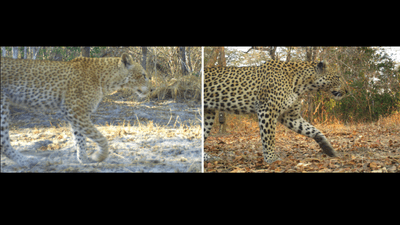


All aboard everyone, we’re back on the funky-colored animal train – and this week’s flavor of choice is strawberry! Strawberry-patterned leopards, to be exact. They join bright blue lobsters, black lynx, and white orcas as among our favorite color morphs to be spotted (see what we did there?) in the wild.
Strawberry leopards are true leopards (Panthera pardus) and not a separate species. They have a rare genetic mutation that, instead of dark spots and facial features, fades or completely removes the black coloring giving them a rare pink or golden hue.
While the cause was previously thought to be linked to excessive production of red pigment as a result of erythrism, researchers have now discovered that the pathways to strawberry-colored fur might be more closely linked to albinism instead. Albinism is a genetic condition causing all-white individuals due to very low levels or the total absence of the pigment melanin within the skin.
Larger numbers of strawberry leopards have previously been reported in South Africa. To explore more about strawberry leopards and assess how frequently they occur in the wild, a team of scientists deployed 319 paired camera trap stations across the Nyerere-Selous ecosystem in southern Tanzania. The cameras captured over 4,000 images of leopards, which could be identified by the team as 373 unique individuals. Just one of these 373 leopards turned out to have strawberry coloration.
Compared to a typical leopard, the female has much lighter spots with a lack of black around her mouth, on her paws, and the back of the ears. However, the team consider the possibility that the female is not a true strawberry leopard and that her coloring is instead part of a natural color gradient. This theory would need further genetic testing to confirm. Far from being disadvantageous to the leopard, the authors write that such coloration could offer a benefit, such as being able to blend better into the landscape.

There are two alternative theories as to how the genetic mutation arose in the Selous Game Reserve. One possibility is that the strawberry leopards from northern South Africa have spread the trait into the Tanzanian population; however, this is unlikely given the vast distance and geographical challenges separating the two. Or, the team explain, the mutation could be the result of inbreeding due to trophy hunting, the reason thought to be behind the higher levels of strawberry leopards observed in South Africa.
The study is published in Ecology and Evolution.