Nature
 PUBLISHED


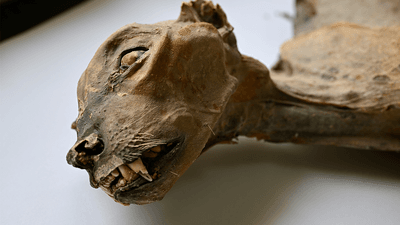


Seven naturally preserved mummified cheetahs have been discovered in a cave in Saudi Arabia. The contents of these caves, which also include the remains of 54 more cheetahs as well as prey animals, shed light on the evolutionary history of these animals across an area in which they are now extinct.
Cheetahs (Acinonyx jubatus) have experienced a severe reduction in available habitat and 91 percent loss of their historic range. Various subspecies live in pockets of Africa, but the Asiatic cheetah (A. j. venaticus), which was once present across Saudi Arabia, is now critically endangered with just a tiny wild population numbering around 50-70 individuals left in Iran.
Historically, it's thought that the last cheetahs were lost from the Arabian peninsula in 1977, when a female was shot by a hunter in Oman. Other threats leading up to the loss of this species from these areas include habitat fragmentation, loss of prey, human-wildlife conflict, and the unregulated trade of cheetahs as pets.
In the Lauga cave network in the Arar region of northern Saudi Arabia, the team behind the new study discovered seven mummified cheetahs and 54 skeletal remains. They set out to establish how old the specimens were, how genetically related the samples were to known cheetah species and subspecies, and how old the specimens were when they died.
Radiocarbon dating of the mummies showed that one of the mummified remains was 4,223 years old and the youngest was 127 years old. Of the 20 skulls that were looked at, 14 were found to be subadults and six were classed as adult cheetahs; the remains of nine cubs thought to be younger than 18 months were also found.
"The gap between the youngest and the oldest ages in the population tells us about the span of occupancy by cheetah in the region and that cheetah were persistent in this landscape for millennia," first author Ahmed Al Boug, of the National Center for Wildlife in Riyadh, Saudi Arabia, told IFLScience. "As important as the gap between the oldest and youngest cheetah specimens is the density of specimens in between; we can now clearly see from the evidence that cheetah continuously inhabited this landscape over this timespan."
Listen to our chat about the preprint of this study from 14:32 in this episode of Break it Down.
For the genetic results, Mummy 1 showed a close relationship with the modern cheetah species A. j. venaticus, while some of the skeletal remains had a closer relationship with the A. j. hecki, the Northwest African cheetah, based on nuclear DNA and A. j. venaticus based on mitochondrial DNA. Both species are now sadly missing from the Arabian Peninsula.
"The genetic evidence clearly indicates that the cheetah habitat in Saudi Arabia was not exclusively used by the critically imperilled population in Iran (A. j. venaticus). The northwestern African cheetah – or its close genetic relative – has used this landscape for extended periods. That tells us the region historically supported cheetahs in a general ecological sense, rather than catering to the peculiar requirements of a single, narrowly defined subspecies," Al Boug explained.
The cats were naturally mummified in the cave system, with a range of ages from over 100 to 2,000 and even 4,000 years old. The constant hot, dry environment of the caves was what allowed the bodies to be preserved for so long. It is possible the cheetah were using the caves as denning sites, though this is not commonly observed in modern cheetahs. The other explanation is that the cheetahs were caught in sinkholes, or entered through a steep slope that they could then not climb back up.
However, Al Boug suggested that the idea of a natural trap is unrealistic. "A simple natural-trap explanation is unlikely. Cheetah were discovered in several caves whose openings do not present a trapping risk. The cave containing the majority of the mummies contains multiple access points to wildlife. In most cases, it appears that cheetah could freely enter or leave the caves in which they were mummified."
The presence of these cheetah specimens, their ages at the time of their death, and their length of time spent within the cave itself, along with the prey items they were found with, all help build up a picture of their historic ecology. This is especially useful in developing rewilding and restoration programs for the area.
"From a conservation perspective, that widens the field considerably," Al Boug told IFLScience. "It allows reintroduction planning to consider African lineages, or at least their genetic diversity, rather than treating Asiatic sub-species as the only conceivable source."
The study is published in Communications Earth & Environment.
Amendment 16/1/26: This article was updated to include quotes from first author Ahmed Al Boug.