Nature
 PUBLISHED
 5
5


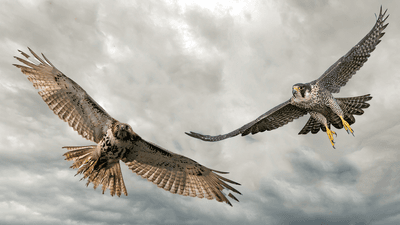


Birds of prey are some of the most impressive species to fly across Earth’s habitats. From the super speedy peregrine falcon to silent owls and majestic eagles, these birds have captured imaginations across the world. But do you actually know the difference between a falcon and a hawk?
What is a falcon?
Falcons are small to medium-sized birds in the family Falconidae, which has around 60 species. The most famous member of the falcons is the peregrine falcon (Falco peregrinus), the fastest bird species in the world that can reach speeds of up to 300 kilometers (186 miles) an hour. To achieve these mind-bending speeds they have sharp pointed wings that fold back against their bodies.
One of the biggest differences between hawks and falcons is their size and subtle differences in appearance. While it varies between species, falcons are usually smaller with pointed wings, writes the Audubon, and they have a more rounded beak shape compared to a hawk.
.jpg "American Kestrel (Falco sparverius)")
True falcons belong to the genus Falco, which contains around 40 species. Six of these species reside in North America, including the American Kestrel (Falco sparverius), Gyrfalcon (Falco rusticolus), and Merlin (Falco columbarius).
Falcons typically nest on cliff ledges, in holes in tree trunks, or on the side of buildings including churches and cathedral steeples.
What is a hawk?
The family Accipitridae contains the hawks, eagles, and some of their relatives. There are around 234 species in this family. Unlike falcons, which have a largely similar build between species, the Accipitridae family has an enormous amount of variation across the species, which include the golden eagle, the sparrowhawk, and the buzzard.
To narrow it down further, true hawks are in the genus Accipiter which includes species like the Eurasian goshawk (Accipiter gentilis) and the sharp-shinned hawk (Accipiter striatus).
Hawks tend to be larger than falcons, with shorter wings. They can be found on all the continents apart from Antarctica. While some species do nest on cliffs like falcons, the hawk family are more likely to be found nesting in trees.
.jpg "Eurasian Goshawk")
The confusion
The relationship between Accipitridae and Falconidae is a little confusing, especially when it comes to common names in different countries. For example, the peregrine falcon has been called the duck hawk in the USA for many years.
Another reason for this confusion is because of the widespread overlapping ranges between many of these species, which makes them difficult to distinguish especially from a distance. With anything like this, practise makes perfect and there are many guides online to help you learn the subtle difference between each species.