Nature
 PUBLISHED
 5
5


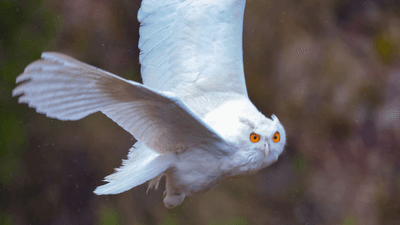


Here at IFLScience, it’s safe to say we have a soft spot for unusually colored animals, from bright lobsters to pink elephants, we can’t resist the color combinations that nature sometimes comes up with. The latest addition is no exception. Meet Blanquita, the first reported case of incomplete albinism in the Eurasian eagle owl (Bubo bubo).
Within the protected Monte El Valle y Sierras de Altaona y Escalona region in southeastern Spain, a female owlet, thought to be around 40 days old, was spotted in a nest during a routine visit to band these chicks as part of a long-term monitoring project. The female, named Blanquita by the team, was the only unusually colored owlet in the clutch of four chicks.

Blanquita's coloring is known as "incomplete albinism" because while her feathers are white, she has bright orange eyes. Albinism is the lack of the pigment melanin which often causes white feathers or fur and pink or red eyes.
The albinism is incomplete in that case because Blanquita had true melanin in their eyes (iris), but also slight black shadow in their wing feathers.
José Zamora-Marín
“The albinism is incomplete in that case because Blanquita had true melanin in their eyes (iris), but also slight black shadow (= subdued barred) in their wing feathers,” José Zamora-Marín co-author of the paper told IFLScience.
As she matured she was fitted with a VHF radio transmitter so researchers could track her movements as she left the nest. Unfortunately, just 10 weeks later Blanquita was found dead around 20 kilometers (12 miles) west of the nest site. Her death was likely due to the ingestion of poisoned rodents which then in turn made her more vulnerable to predators. The team wrote that they found “showed signs of mammal scavenging” in the area.

“We think that Blanquita could have predated on rats or other rodents affected by recent rodenticide consumption, thus causing sublethal effects (reduction of basal activity) through secondary exposure and making her vulnerable to predation by a canid (red fox or dog). In turn, the remains of the wings and body found by us showed signs of canid consumption or scavenging,” continued Zamora-Marin.
The short life of Blanquita does not give any insights into what might have happened for her life in terms of breeding and mate selection but does highlight the struggle of unusually colored animals to survive and maintain camouflage at roosting sites.
The report is published in Frontiers in Ecology and the Environment.