Nature
 PUBLISHED


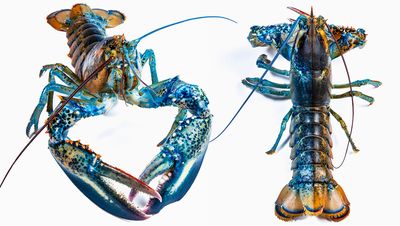


As far as rare colorations go, funky-looking lobsters seem to be pulled out of the ocean pretty regularly, and in the name of science, The University of New England (UNE) in Maine is building quite the collection of these beautiful beasts.
While lobsters usually come in orange or red, they also have a peculiar tendency to appear in virtually every other color too. Fishing vessels have caught examples of bright blue, yellow, calico, seemingly transparent, and even split-color lobster variations, with many either being released or donated to research centers. Now, a team at UNE has launched a study into the genetic mechanisms behind these extraordinary variations.
Research into and knowledge surrounding these color variations is currently limited, but with the help of UNE’s growing collection, that could soon change. “At this point, no one really knows in detail why some lobsters develop these multicolor variations,” Markus Frederich, professor of marine sciences at UNE said in a statement, “though we do have some theories.”
“We have access to all these different lobsters, and we have the students who are eager to do the research. We thought, ‘Let’s jump on this.’”

UNE is currently home to (IFLScience favorite) Banana the bright yellow lobster, as well as Currant, who is a blue-brown split, and Fig, a baby purple lobster. The genetic makeup of these species will be decoded in the hope of identifying the genes responsible for the seemingly random color anomalies.
In their investigation efforts, the team highlighted the need for developing non-invasive testing methods that won’t harm the lobsters. In addition to being able to feel pain, the specimens held at the university range in rarity from around one-in-30 to one-in-50 million, so their protection is vital to the research.
Additionally, the team is tending to the eggs of an orange lobster, which are expected to hatch this spring, with the aim of monitoring the proportion of offspring that emerge as orange.
Despite currently holding a healthy and diverse range of rare lobsters, when studying genetic diversity and abnormalities, the more the merrier. Frederich plans to establish a sustainable research partnership that allows local lobstermen to send rare specimens to UNE for study before their release back into the wild.
“This is the type of project that plays to both UNE’s strengths and our goals,” said Charles Tilburg, academic director of UNE’s School of Marine and Environmental Programs. “Dr. Frederich and his team are performing novel, interesting research while partnering with a local industry, providing outstanding training for our students, and answering important questions in the field.”