Nature
 PUBLISHED
 1
1


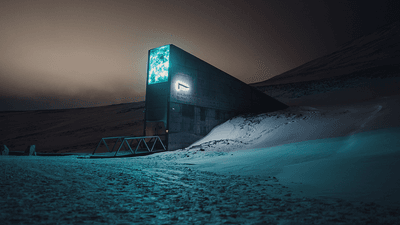


It has come to our attention that people are a little confused about the purpose of the Svalbard Global Seed Vault.
Sometimes referred to as the "doomsday vault", the seed vault contains over 1,385,898 seed samples collected from around the world. The idea behind the vault is that it acts as something of an ark for important plant species and varieties.
Placing it within the Arctic Circle means that the (hopefully) permanently frozen soil will keep the seeds at a breezy -18°C (-0.4°F), with little exposure to oxygen to prevent them from aging. Stored in this way, the seeds should last for decades, or perhaps even a century, protecting Earth's crop varieties from natural catastrophes, war, and other avoidable disasters.
Where the confusion arrives is in how people seem to picture the vault being used.
On Reddit, one user posting a question to the "no stupid questions" subreddit appears to think that the vault is there for use after an unspecified apocalypse, allowing survivors to withdraw seeds to be planted once that event has taken place.
"I am one of the last people on earth - can I open the Seed Vault in Svalbard or will it be locked?" the user asked. "How am I supposed to use the seeds in catastrophe if its locked?"
As people have pointed out, after an apocalypse you'll likely be free to head down there and attempt to smash your way in with whatever tools you can loot from a garden center. However, it might also be easier to simply loot seeds from said garden center, as the Svalbard Global Seed Vault isn't so much a seed shop for apocalypse mutants, but more of a way of safeguarding crop varieties for the future.
"This is particularly important given the increasing reliance on food monocultures, which are vulnerable to devastating harvest failures," a 2022 paper on the topic explains.
"By stockpiling these seeds in one of the most remote areas of the world, free of charge, vault officials explained that they were protecting crop varieties from their destruction locally whether from conflict, changing climatic conditions, the onset of disease, or simple mismanagement."
"The 65,000 tightly packed and carefully labelled accessions that were slowly marched into the frozen vault represented a key commitment to secure the world's food supply, now and for the future."
The main purpose is to store seeds already found at other seed banks around the world, making the vault something like a backup for our backups.
"The Seed Vault is an insurance policy for other genebanks. Plant breeders, researchers and farmers depend on genebanks around the world to obtain the crop diversity that they need," NordGen, who run the seed bank, explains. "If those genebanks lose their own resources, because of natural or man-made disasters, the collections can be restored by retrieving the duplicates from Svalbard."
Withdrawals from the seed bank are rare, but not unheard of. Due to the ongoing conflict in Syria, in 2015 the International Centre for Agricultural Research in Dry Areas (ICARDA) in Aleppo was unable to continue functioning. As a result, ICARDA withdrew 42,729 samples, including seeds of wheat, barley, and peas, to stock new facilities located in Terbol, Lebanon, and Rabat, Morocco.
While in the event of a global apocalypse, we suppose you're free to knock yourself out and attempt to loot the vault, its main protection is not the building itself but its remote location. If you can dodge the zombies munching their way around the landscape, you'd have to somehow get yourself to the freezing island of Svalbard.
If you did manage the journey, then the vault itself doesn't actually have a permanent human presence. NordGen staff only enter the facility when necessary to make a deposit or withdrawal, meaning you'd also have to know what you're looking for. Even the staff aren't allowed into the actual seed samples.
"The seed boxes are stored under 'black-box conditions,' meaning the depositors are the only ones who can withdraw their own seeds," NodGen writes, adding that the legal ownership of the seeds remains with the depositor. "This means that a depositor who chooses to store seeds in the Seed Vault is still the owner of the seeds and the only one who can withdraw them from the Seed Vault."
"While the seeds are stored in the Seed Vault, only NordGen personnel are allowed to handle the seed boxes."
In short, you could try and break into the seed vault after an apocalyptic event, but you might find it easier to break into a more local garden center, or perhaps you could engage in some foraging? Unless, of course, there is a very specific variety of seed you're looking for that has been wiped out in the meantime.
Then, with everyone else dead, you're free to enjoy your very specific variety of heirloom corn and ancient barley. The billions of dead will not begrudge you that, assuming you didn't set the apocalypse off in the first place.