Nature
 PUBLISHED
 1
1




Indonesia’s current capital is in deep trouble. Drained of its vital groundwater reservoirs, Jakarta has become one of the fastest-sinking cities in the world. If left to nature, up to 25 percent of its land could be lost to the sea by 2050. The metropolis is also wracked with other common problems faced by emerging urban centers, such as heavy traffic, poor sanitation, dangerous air pollution, and shortages of drinking water.
To relieve this logistical nightmare, Indonesia has drummed up a plan: relocate the capital from Jakarta to Nusantara in East Kalimantan – a city that doesn’t exist yet. This master plan involves the translocation of the capital’s administrative infrastructure, plus around 1.9 million people, from Indonesia’s main island Java to the sparsely populated island of Borneo.
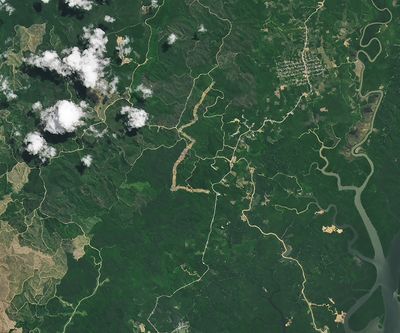
The idea of reshifting the capital was put into Indonesian law in 2022, when the proposed site of Nusantara was a jungle. Satellite images shared by NASA Earth Observatory show how the area was a vast green expanse of tropical rainforest in April 2022.
By February 2024, however, images from the same vantage point show how the settlement is slowly starting to take form. The new satellite images reveal how soil has been exposed to make way for a network of roads and infrastructure development amidst the wild backdrop.

The Nusantara website states that the first phase of the capital relocation project – set to conclude in 2024 – will see the country move its state palace and parliament building to the site this year. As per the plan, the President of Indonesia will celebrate the 79th anniversary of the country's independence at the site in August 2024. All being well, construction of the whole city will be done and dusted by 2045.
Judging by the recent satellite imagery, there is still a very long way to go before Nusantara becomes the proud capital it dreams to be.
Critics have started to hit out at the Indonesian government, arguing there’s a lack of transparency on the progress of the project.
As ever, money is a problem. Many people are worried there’s a lack of funding behind the project and not enough foreign investors are being pulled by its promise. Likewise, some commentators have expressed doubt over whether there will be access to affordable housing in Nusantara.
There are also big concerns about its environmental impact. The government claims Nusantara will be run on 100 percent renewable energy by 2045 while promoting it as a “smart, green, beautiful, and sustainable city”. However, many scientists believe it could increase deforestation in Borneo and increase Indonesia's carbon output.
“Deforestation emissions from the new capital’s direct (30 kilometers [18.6 miles]) and indirect (200 kilometers [124.3 miles]) footprint could be approximately 50 MtCO2e [megatonnes of carbon dioxide equivalent] and 2326 MtCO2e, respectively, equivalent to 2.7–126 percent of Indonesia’s 2014 greenhouse gas emissions,” said a 2020 paper on the topic of Nusantara.
Borneo is a hive of biodiversity and home to numerous critically endangered species like the Bornean orangutan and Sumatran rhinoceros, as well as charismatic characters like the clouded leopard. Authorities insist that wildlife will be given the utmost protection, but environmentalists are still weary.
In June 2023, Mongabay shared footage of an orangutan crossing the construction site of a planned toll road, clearly highlighting the potential disruption caused by dropping a new city into the middle of a jungle.
“Fortunately, the new capital is sited on a coastal site more than 200 kilometers [124.3 miles] away from the Heart of Borneo ecoregion, which will spare Borneo the brunt of the immediate direct impacts. However, indirect spatial impacts can be very large, and along with environmental justice issues arising from further marginalization of disadvantaged groups, present a significant downside to the new capital’s development that must be preempted,” the 2020 paper continues.