Nature
 PUBLISHED


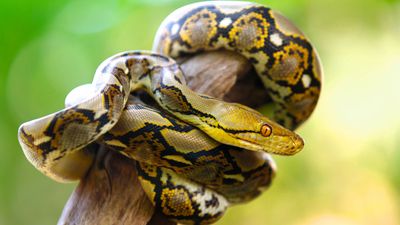


Earth may not host kaiju-level behemoth snakes like Titanoboa or Vasuki anymore, but it still has some pretty large specimens. Case in point: Ibu Baron – Indonesian for The Baroness – a 7.22-meter (23 feet, 8 inches) long reticulated python and, per Guinness World Records (GWR), officially the longest known wild snake in the world.
Ibu Baron: The Baroness
“I had never seen a snake this big,” Radu Frientu, an explorer and natural history photographer who verified Ibu Baron for the bar trivia company, told National Geographic last month. Local to Bali, he traveled to Maros, in South Sulawesi, Indonesia, to weigh, measure, and snap photos of the record-breaking snake in the region where she was found late last year.
The verdict: “This snake could easily swallow at least a calf, if not an adult cow,” said Frientu. She’s almost as long as a London bus – 3.5 times the length of a queen-sized bed – and at 96.5 kilograms (213 pounds), roughly the same weight as a giant panda.
And here’s the kicker: those are likely underestimates. Ibu Baron’s weight was taken on an empty stomach – had she eaten before the weigh-in, she could easily have surpassed 100 kilograms, GWR says – and she was measured while awake. Under sedation, her muscles would fully relax, stretching her body out to 10 or 15 percent longer. “In reality her true length is likely nearer 7.9 m (26 ft),” GWR says.
“But owing to the inherent risks of anaesthetic, GWR believes that animals should only ever be ‘put under’ for safety reasons or necessary medical procedures,” the company adds, “so this has not been put to the test.”
Instead, Ibu Baron was measured with a surveyor’s tape, which could follow her curves. She was weighed using specialist scales usually reserved for large bags of rice – the Baroness was placed inside “a big canvas sack” for the procedure, GWR notes.
It’s probably the best and most official we can get, but it’s worth pointing out that such methods might not pass scientific muster. “Flexible measuring tapes, even cloth ones from fabric stores, are […] insidiously difficult to use reliably, because the darn snake rarely will sit still,” pointed out Joe Mendelson, Adjunct Professor at Georgia Tech and Director of Research at Zoo Atlanta, in 2017, and “[even] length measurements taken from anesthetized snakes are not correct!”
Why? Well, “it appears that an individual snake does not actually have a consistent length,” Mendelson explained. “Snakes have hundreds and hundreds of vertebrae, with a small, slightly compressible cartilaginous disc between each pair. As the waves of muscular contractions move rearward along a snake’s body, these discs are serially compressed or not. Because there are hundreds of these discs, the length of the snake changes slightly, but actually, every moment.”
A lengthy species
It’s not surprising that the longest snake in the world would be a reticulated python. They’re known to be, on average, the longest snake species, reaching up to 6 meters (19 feet 2 inches) without too much trouble, and even surpassing that on a few notable occasions. The longest known snake ever, for example – a haunted house resident from Kansas City, Missouri, named Medusa – was also a reticulated python, and she was a stonking 7.67 meters (25 ft 2 inches).
“I do not believe in the slightest that this is the largest wild snake. I got lucky,” Frientu told National Geographic. “There are still wonders out there. This is one of them—and I don’t think it’s the last.”
Even longer individuals have been reported – but, crucially, never verified. Thanks to their size, their “fashionable” skin, and their fearsome reputation, the biggest reticulated pythons rarely survive long after being discovered: “These giant animals attract attention as status symbols,” Frentiu told National Geographic. “They tend to disappear, or something bad happens to them.”
It is, to a certain extent, understandable. Reticulated pythons aren’t venomous – they subdue their prey by constricting them. But that doesn’t mean they’re not dangerous: “Big pythons are incredibly powerful animals with huge muscles to both move and eat and constrict,” Stephen Ressel, a herpetologist and faculty emerit at the College of Atlantic, told USA Today back in 2017. “They certainly can pack a huge force as they're constricting.”
In fact, reticulated pythons not only easily kill humans, but they eat us too. There are dozens of documented cases of the snakes having fully devoured people in Indonesia and the Philippines alone, and many more likely go unreported. Pythons can digest flesh and bones alike, and rarely leave any evidence of their kill – besides, you know, the annual poop.
It’s not surprising, then, that the animals are not exactly welcomed by the locals who find them. “A python this big will probably be drawn toward a village,” Frentiu told National Geographic. “And once that happens, it will almost certainly be killed.”
Hope for the future
Ibu Baron’s biggest claim to fame, therefore, is less her size than her simple continued survival. And for that, she has one man to thank: Budi Purwanto, a local conservationist who, when hearing of this monster-sized snake, took her in and made a shelter for her on his property. It’s something of a home-made sanctuary for snakes in the area, protecting both the reptiles and the local people.
“Our hope is for pythons and other giant snakes to no longer be seen as vermin, but rather as a symbol of the islands and necessary animals to the ecosystem,” Frientu told GWR. “They can be a local wildlife treasure to generate tourism, encouraging ever-more popular herpetological safari trips (known as ‘herping’). All these things could bring revenue to local people, create awareness, serve conservation and boost local pride.”
As Indonesia’s lush wildlife habitats continue to decline, however, humans and pythons are coming into contact ever more frequently. It’s bad news for both species – but it’s a problem with known solutions.
“Appearances of these giant snakes are increasing because their habitats are reducing and availability of the snake’s natural food [such as wild pigs and wild anoa cattle] is decreasing,” said Diaz Nugraha, a wildlife guide, conservationist, and licensed snake handler who helped Frientu assess Ibu Baron. That’s “likely as the result of poaching, meaning pythons are coming into contact with people more often than in the past.”
But “there are methods that can be applied to reduce contact between humans, their livestock, and snakes, as well as better maintain the natural food chain and ecosystem,” Nugraha said. That way, “snakes will come less to villages looking for prey.”