


 Nature
 PUBLISHED



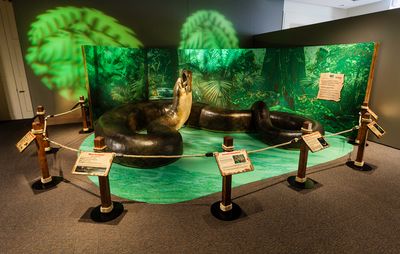


Ophidiophobics, look away: things are about to get gnarly in a very snakey way.
Snakes are, undeniably, demon animals. No, no: enough of the “danger noodle” chat; they’re not cute – especially the really huge ones that can easily chow down on a whole deer, hyena, or, y’know, you.
But for all that these images are awful, we’re really quite lucky. For the creatures hanging out in the Palaeocene and Eocene eras, just after the demise of the dinosaurs, there were much, much bigger problems afoot – or should we say… aslither.
Titanoboa: the prehistoric behemoth
About 66-56 million years ago, in northern Colombia, a huge predator was roaming the land. Its name: Titanoboa cerrejonensis. Its clade: Ophidia, suborder Serpentes. Its size: gargantuan.
The beast was first discovered in the early 2000s by researchers from the Smithsonian Tropical Research Institute and the University of Florida. Digging in the Cerrejón coal mines of northeastern Colombia, they uncovered close to 200 fossils – “Wherever you walked, you could find bone,” Jonathan Bloch, a palaeontologist from the University of Florida who worked on the excavation, told Smithsonian Magazine in 2012.
The cave was pretty much a palaeontologist’s paradise. Back in the Palaeocene, some 60 million years ago, the area now known as Cerrejón was a massive, swampy jungle. It rained almost twice as much as the modern Amazon rainforest; trees and vegetation flourished, and so did the wildlife. Turtles, crocodiles, fish: all could be found at sizes two or three times that of their modern descendants – and Titanoboa was no exception.
“It’s probably an animal in the 30- to 35-foot range,” Bloch said at the time – though later estimates would push that figure even higher, up to around 14.3 meters (47 feet). That’s about as long as the biggest semi-trailers on US interstate roads, though at 1,135 kg (2,500 lb), the snake only weighed about half as much as a rhino.
And the weirdest part of all? It was nearly missed completely. The first Titanoboa fossil was a single vertebra that had been thrown in with a shipment of “crocodile” remains. If it wasn’t for Alex Hastings, at the time a University of Florida palaeontology grad student who happened upon those ancient bones, it might have ended up like so many other species, languishing in a drawer for decades – but instead, Hastings clocked it for what it was: a snake vertebra.
Further expeditions – as well as delving into the specimens already in storage – unearthed 100 gigantic snake vertebrae from 28 different animals. “We’d had some of them for years,” Bloch recalled.
“My only excuse for not recognizing them is that I’ve picked up snake vertebrae before. And I said, ‘These can’t be snake vertebrae’,” he said. “It’s like somebody handed me a mouse skull the size of a rhinoceros and told me ‘That’s a mouse.’ It’s just not possible.”
Vasuki: a challenger appears
For more than a decade, Titanoboa was the undisputed heavyweight champion of the snake family. But in 2024, a new king of the slitherers was announced: Vasuki indicus.
“The largest of its vertebrae is 11 cm wide,” Debajit Datta, a palaeontologist at the Indian Institute of Technology in Roorkee and one of the two researchers who first described the species, told Nature at the time. That’s almost 4.5 inches across – more than twice the width of even the widest of your backbones – and when used to model the snake’s overall size, it revealed something almost unimaginable.
“The largest body-length estimates of Vasuki appear to exceed that of Titanoboa,” Datta and coauthor Sunil Bajpai wrote in their paper describing the snake. While warning that “caution is warranted” regarding the figures – basically, Vasuki was from a family of snakes that no longer exists, so nobody’s entirely sure how similar its body layout was or wasn't compared with modern snakes. Widely-accepted mathematical models place the snake’s length at around 11-15 meters (36-49 feet; 12-16.4 yards; literally taller than a brachiosaurus, if only snakes were able to balance upright on the tip of their tails).
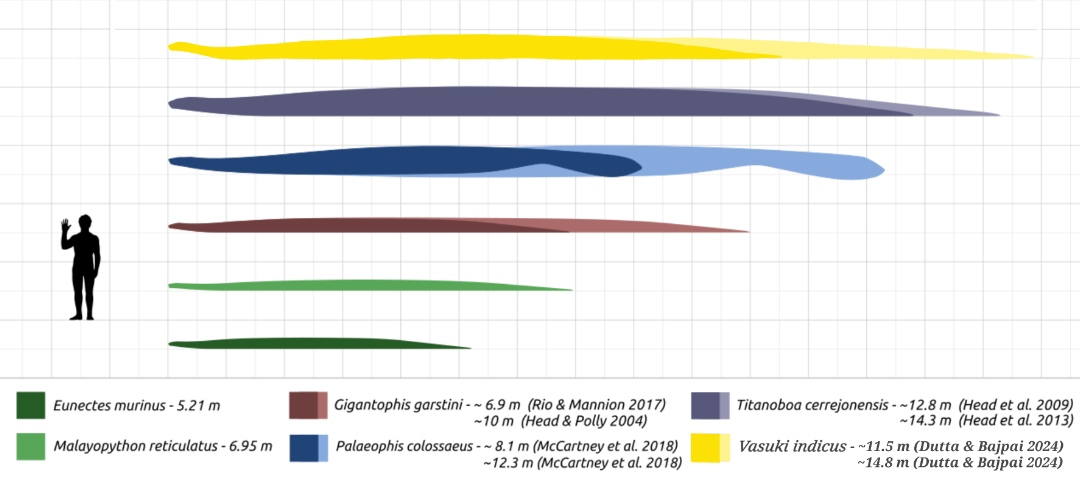
Vasuki was a little younger than Titanoboa: it lived around 47 million years ago on the Indian subcontinent – hence the name indicus. Despite that, it’s also the earliest-known member of its family, the madtsoiid snakes: “Since this group was dominated by madtsoiids from India and Vasuki was the most primitive ancestor in the family tree, we inferred that this group of snakes originated in India,” Bajpai told Nature.
So, if you found yourself ported to the Eocene era and face-to-face with a Vasuki, should you be scared? Well, yes, obviously: it’s a gigantic-ass snake. But perhaps you can take heart from the fact that, like Titanoboa, it appears to have mostly eaten marine life.
“No land mammals were found” in the rock unit that yielded Vasuki, Datta and Bajpai told IFLScience back in 2024.
“It is difficult to say at this point precisely what sort of animals Vasuki preyed upon,” they said – but “rays, sharks, catfish, turtles, crocodiles, and primitive whales” were the only other fossils found around its remains. So… stay out of the water, we guess.
Modern weenies
So, compared with tens and hundreds of million years ago, it seems we’re really pretty lucky. The longest snakes known today don't exceed 10 metres, with the world record holder right now being Ibu Baron – "The Baroness" – a female reticulated python measuring 7.22 meters (23 feet) tip to tail.
“Under anaesthesia, when snakes’ bodies fully relax, she could be at least 10 percent longer,” Guinness World Records pointed out earlier this month. “So in reality her true length is likely nearer 7.9 m (26 ft).”
Ok, maybe that’s not much of a consolation. But there is this: for now, at least, snakes likely can’t grow to the kinds of sizes seen in times gone by.
“Snakes are poikilotherms,” Bajpai and Datta told IFLScience, meaning “their body temperatures are dependent on the temperature of their ambient environment, which in turn controls their body size.”
Thus, the much higher mean temperatures of the Palaeocene and Eocene world allowed for these gigantic snakes – but today’s comparatively cooler environment simply couldn’t support them.
And we know what you’re thinking: “but IFLScience, we’re warming the planet up at unprecedented rates! Before long, the world will be just as warm as it used to be! What then?!” And we hear you, we do, but this may be the one single upside to the speed at which humans are wreaking a climate apocalypse upon the planet.
“High temperatures spur the development of large bodies in snakes and other cold-blooded organisms,” Datta told Nature, but “current temperatures are rising too fast for these snakes to become as massive as they did in the past.”



 1
1