Space and Physics
 PUBLISHED


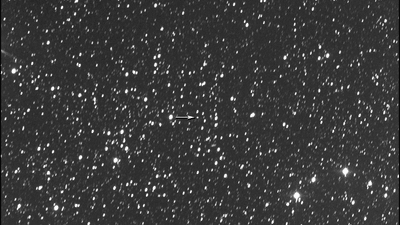


Potentially hazardous asteroid 152637 (1997 NC1) is about to make its closest approach in over 400 years, in an event only seen once every decade. At these distances, and given the size of the asteroid, it should be possible to view using a small telescope, or even binoculars.
Earth has gotten pretty good at monitoring the skies for potentially hazardous asteroids, or larger objects on courses that could see them potentially colliding with the Earth and doing significant damage. In our time scouring the Solar System, we have found no known asteroids that pose any danger to Earth for the next 100 years, at least.
152637 (1997 NC1), discovered in 1997 by NASA's Near-Earth Asteroid Tracking (NEAT) program, is no exception. Observing the object several times and calculating its orbit, the asteroid is not expected to impact the Earth anytime soon. But it is an Aten-class asteroid, meaning that its path does bring it in close proximity to Earth on its journey slightly beyond the orbit of Earth, and taking it within the orbit of Venus.
On June 27, 2026, the asteroid will make an especially close approach to the Earth at a distance of around 0.01715 astronomical units (AU), with one AU being the average Earth to Sun distance.
That's close enough to be exciting (more on that in a moment), but at around 2,565,600 kilometers (1,594,100 miles) away, or around 6.5 lunar distances, it's a nice and comfortable "miss" of planet Earth. It is also the closest approach the object has had in at least 400 years, with 1600 CE being the furthest back that the object's path has been computed.
It will make a closer approach at around 0.01699 in the future, but unless you have the secret to immortality handy you will miss it, taking place on June 28, 2133.
So far, observations have shown us that the asteroid is quite a large one, but we aren't altogether too sure how large it is. This isn't because astronomers haven't bothered to measure it, but because it is difficult to gain an idea of an asteroid's sign from the light it reflects alone.
"Visible light from the sun reflects off the surface of the rocks. The more reflective, or shiny, the object is (a feature called albedo), the more light it will reflect," NASA explains. "Darker objects reflect little sunlight, so to a telescope from millions of miles away, a large dark asteroid can appear the same as a small, light one."
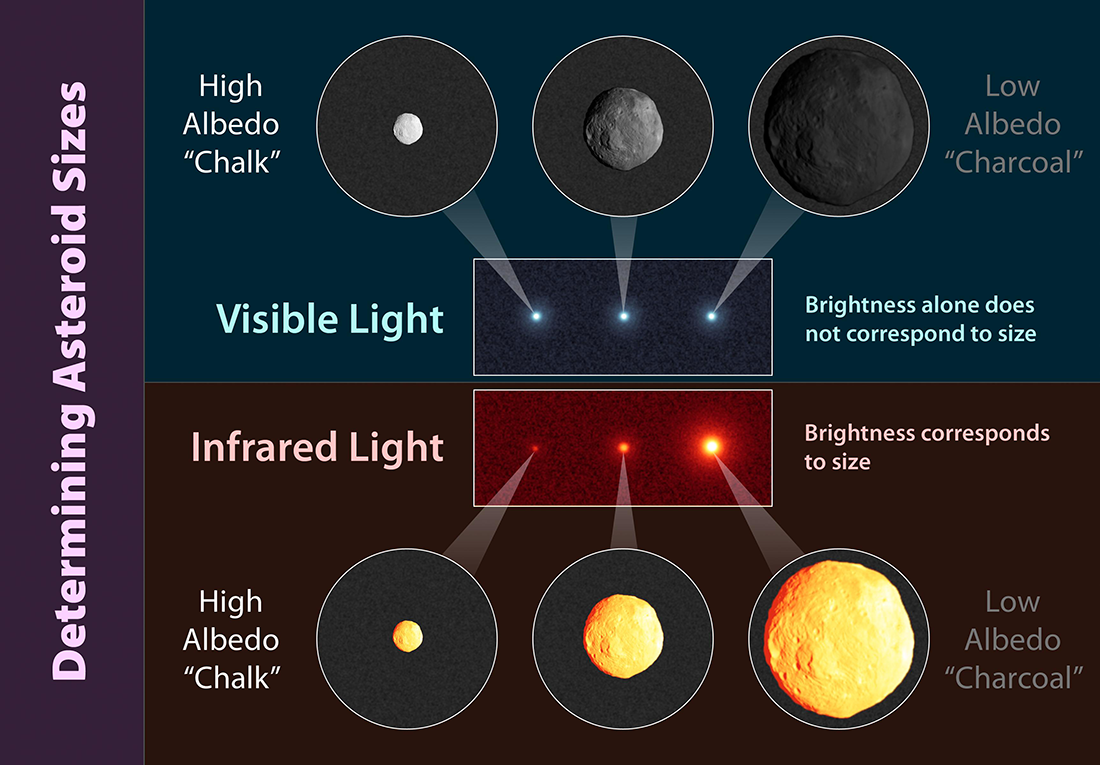
As far as we can tell, asteroid 152637 (1997 NC1) is pretty big, but this latest close approach will give astronomers the opportunity to pin down how big.
"The absolute magnitude of 17.9 suggests a diameter within a factor of two of 900 meters [2,953 feet]. The diameter, optical albedo, and spectral class have been measured but give conflicting results," NASA explains. "If this object is an optically-dark B-type, then the diameter could be close to 1.5 km. We plan to use radar observations to help resolve the discrepancies regarding the diameter, spectral class, and optical albedo."
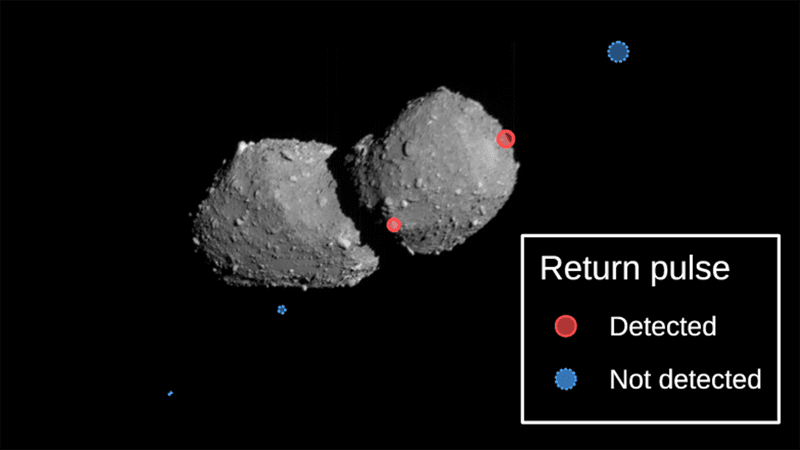
NASA plans to conduct observations on the object during the close approach, using the Goldstone Solar System Radar (GSSR).
“Every other technique in astronomy depends on reflected sunlight or emitted radiation,” Marina Brozovic, a radar astronomer at NASA’s Jet Propulsion Laboratory, explained to Eos. “We bring our own flashlight, and the echo comes back carrying lots of valuable information from super precise measurement of where that object is in space to physical characteristics [like] how fast it’s spinning.”
Using the GSSR, astronomers will hopefully be able to pin down more properties of the asteroid, with the next close approach not taking place until 2088. As well as being an opportunity to look at this specific asteroid, approaches by asteroids this size only take place around once every decade.
"The 2026 flyby distance is unusually close for an object this large," NASA adds. "The last encounter closer than this by an object with a brighter absolute magnitude (and presumably a larger diameter) was in January 2022 by 1994 PC1 (H = 16.6), which approached within 5.2 lunar distances (0.0133 au)."
During the approach, the asteroid is expected to peak at around magnitude 10, making it visible with small telescopes or perhaps even a decent pair of binoculars, though the brightness of the Moon may interfere with this somewhat.
It will be visible from northern locations as the asteroid approaches us, while southern viewers will be able to get a view of it as it recedes from Earth.
If you are unable to see it for yourself, the Virtual Telescope Project is planning on live-streaming observations on June 26 and 27, both beginning at 23:00 UTC. Better watch, with the next opportunity coming long after you are dead. Though just to reiterate, that won't be the asteroid's fault.