Space and Physics
 PUBLISHED


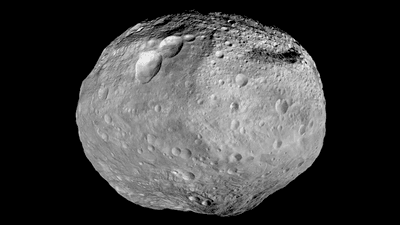


A new preprint paper has looked into how we could measure the mass of a potentially hazardous asteroid during a high-speed flyby.
NASA, as well as other observatories, keep track of various potentially hazardous objects making their way through the Solar System, keeping a particularly close eye on "near-Earth objects" (NEOs) 140 meters (460 feet) and larger in size, for the devastation they would cause if they were to hit Earth. By observing their orbits, astrophysicists are able to estimate the future orbits of the objects, and predict whether they potentially put them in our part of the Solar System.
Since astronomers began tracking asteroids, despite a few worrying moments, we haven't spotted any that pose any imminent danger to Earth. In fact, looking at the known objects out there, NASA have ruled out a potentially hazardous asteroid impact for the next 100 years.
Nevertheless, if we were to spot an object that could impact Earth, we would need to be able to measure its mass before we could decide what to do about it. Options on this front include the chance to redirect it, as NASA have trialed with the DART mission, and measuring the object's mass would be important if we were to consider such drastic action.
Measuring the mass of a small space object, as fans of the 3I/ATLAS saga will no doubt be aware, isn't as simple as you'd hope.
"The asteroid’s mass determines the potential impact effects at Earth and the momentum required by a mitigation mission to deflect it," the team explains in their new paper, which has not yet been peer reviewed.
"For asteroids of the size scale relevant to planetary defense (i.e., ∼50-500 m), the mass can only be directly measured in-situ with a dedicated reconnaissance spacecraft that performs either a high-speed flyby or an extended rendezvous."
In short, a flyby can detect the mass of an object by measuring tiny changes to the acceleration of the spacecraft caused by the object's gravitational pull. The problem is that even with flyby missions, the amount of acceleration felt by the spacecraft is teeny tiny, requiring a close approach by the spacecraft, and even then smaller objects may not produce enough acceleration to be measured.
Here's where a neat little trick from the new paper, by authors from Johns Hopkins University, the University of Colorado Boulder, and NASA's Goddard Space Flight Center, comes in. They propose a new method of measuring the mass of an object during a high-speed flyby, where the spacecraft releases a cube satellite (CubeSat) around 10 kilometers (6.2 miles) from the asteroid.
"Both spacecraft perform approach maneuvers to target their flyby locations, with the host targeting a close proximity flyby and the CubeSat targeting a distant flyby," the team explains. "By incorporating short-range intersatellite measurements between the host and the CubeSat, the mass measurement sensitivity is substantially improved."
While the CubeSat makes a flyby at around a fun run's distance, the main spacecraft would have to approach the hazardous asteroid far closer, coming within 1-3 body radii of the object.
"The test-mass’s trajectory is unperturbed and serves as a ballistic reference to compare the host’s trajectory against," the team explains. "The relatively short distance between the host spacecraft and the test-mass facilitates high accuracy intersatellite measurements, which when coupled with the low flyby provide a very sensitive mass measurement."
It's a neat idea, and could potentially be used to measure the mass of an asteroid, should the need arise. However, the team found that it would still be tricky to achieve such a mission. Smaller asteroids could still be too tiny to measure using this method, for example.
Meanwhile, modeling a potential mission to asteroid 2024 YR4 – the asteroid that briefly made headlines a few years ago when it looked like it might have a chance of hitting Earth, but now has around a 4 percent chance of hitting the Moon – the team found there were difficulties here too. In short, uncertainties about the trajectory of the asteroid prohibit being able to make a safe and close approach.
The team hopes to refine their idea further, so that more asteroids could potentially have their masses measured by such a mission, with options to explore including sending multiple spacecraft, and a future deep space radar constraining asteroid trajectory uncertainties ahead of an approach.
The study is posted to preprint server arXiv.