Nature
 PUBLISHED


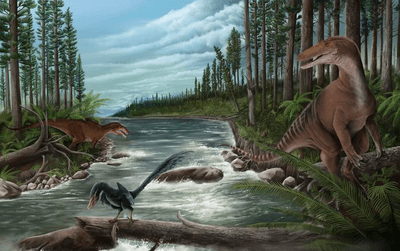


Five dinosaur specimens discovered near Australia’s south-eastern coast have shed light on the region’s Cretaceous predators. The finds come from fossil beds hundreds of kilometers and millions of years apart, but suggest a hierarchy between large, medium, and small-bodied predator families at the time.
To the general public, the most exciting discovery involves the oldest megaraptorids ever found. The name itself suggests this was a dinosaur worthy of Hollywood’s attention, and the animals’ size confirms this is not hype. Although only fragments have been found, these 120 million-year-old theropods are thought to be about 6-7 meters (20-24 feet), only half the size of a T-Rex, but still plenty terrifying and among the largest carnivores ever found in Australia.
Scientifically speaking, however, the more significant discovery is of two carcharodontosaurs, previously only known from South America. At 2-4 meters (7-13 feet), unless they were juveniles, these carcharodontosaurs would have focused on smaller prey than the megaraptoroid, although they may have overlapped.
“The discovery of carcharodontosaurs in Australia is groundbreaking,” said Monash University PhD student Jake Kotevski in a statement. ‘It’s fascinating to see how Victoria’s predator hierarchy diverged from South America, where carcharodontosaurs reached Tyrannosaurus rex-like sizes up to 13 meters, towering over megaraptorids. Here, the roles were reversed, highlighting the uniqueness of Australia’s Cretaceous ecosystem.”
Australian conditions have been worse for preserving fossils for a very long time than other continents, leaving large holes in our knowledge of Australian fauna in the dinosaur era. Much of what we do know comes from the efforts of husband and wife Dr Thomas Rich and Professor Patricia Vickers-Rich, co-authors on this paper.
“The findings not only expand Australia’s theropod fossil record but offer compelling evidence of faunal interchange between Australia and South America through Antarctica during the Early Cretaceous,” Rich said.
Previously, most Australian carnivorous dinosaur fossils were of small to medium-sized megaraptorids, along with some smaller species such as abelisauroids.
The most surprising aspect of the discoveries is the way the carcharodontosaurs apparently adapted on finding the apex carnivore niche filled. Curiously, the most similar known carcharodontosaur to these two lived in southeast Asia, then much more distant from Australia than it is today.
Although three of the specimens the team studied were collected in 2022-23, two others were fossils found decades ago that were so damaged that palaeontologists couldn’t identify their source at the time. These sat in the Museums Victoria collection until other discoveries and new analysis techniques enabled the team to make sense of what they were looking at.
Two of the discoveries were carcharodontosaur tibia (shin bones). These were collected south-east and southwest of Melbourne from deposits dating to around 110 and 120 million years ago respectively, proving the persistence of this dinosaur family.
The two megaraptorid vertebrae are associated and counted as one specimen; another tibia found nearby was from a megaraptorid of similar size. Each of these is thought to have come from a creature larger than Australovenator, Australia’s largest named theropod. However, two previously found specimens from unnamed species may be larger still.
The final discovery, yet another tibia – it seems Aussie theropod shinbones were built to last – came from an Unenlagiinae, a smaller-bodied theropod clade previously only known in this region from later in the Cretaceous.
The specimens were so incomplete, and in some cases so damaged, that the authors did not attempt to assign them to specific species or genus. Nevertheless, they think each carries features distinctive enough to identify the clade.
The work follows the recent discovery of large theropod footprints in slightly older rocks near where most of these specimens were found. Southern Australia was so close to the South Pole at the time there were once questions as to whether dinosaurs, and specifically theropods, could survive winter there. Now we know the region could support many of greatly varied sizes.
The study is open access in the Journal of Vertebrate Paleontology.