Nature
 PUBLISHED


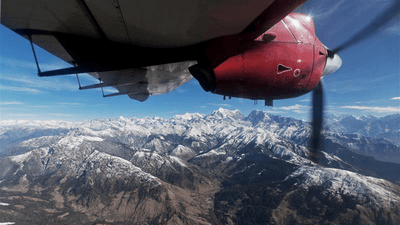


If you look at the flight paths of planes traveling around the world, you may notice a few oddities. One is that they don't appear to travel in straight paths to their destinations (the answer to this one is fairly obvious) and, if you really go into detail, that very few planes seem to fly over Tibet.
If you know anything about the Tibetan terrain, it's that it contains a lot of mountains and elevated plateaus. While this might not seem like a problem for planes – which can simply fly higher than the mountains – they are the reason why aircraft tend to avoid flying over the region.
One problem with flying over Tibet is that the mountain ranges result in a lot of turbulence.
"In its most simple sense, turbulence is a disturbance in the air, and is not unlike the movement of waves and sea currents. If there are no obstacles in the way of an incoming wave it will 'flow' nicely, but if it hits a sea wall, say, it will break up and you can see the disruption to the wave," Darren Ansell, Space and Aerospace Engineering Lead, University of Central Lancashire, explained in a piece for The Conversation.
"As air flows over man-made structures and natural terrain such as mountains, the air flow is disrupted and causes the air above and around it to become turbulent. So if you take off or land from an airport close to a mountain range or very hilly terrain you are more likely to experience this kind of turbulence during and shortly after take-off."
While it is possible to fly over Tibet, the mountain ranges can lead to a bumpy ride. Another problem is safety. Planes fly far higher than the average 5,000-meter (16,400-foot) elevation in the region. But should the cabin depressurize (a rare event), pilots may need to descend to around (3,000 meters) 10,000 feet where the air is breathable, before looking to land in a nearby airfield. This is a bit of a problem when descending to that height would simply crash you into a mountain range.
For these reasons, as well as a lack of areas where an emergency landing could be carried out, planes that are not landing in the area's airports tend to avoid flying over Tibet.