Nature
 PUBLISHED


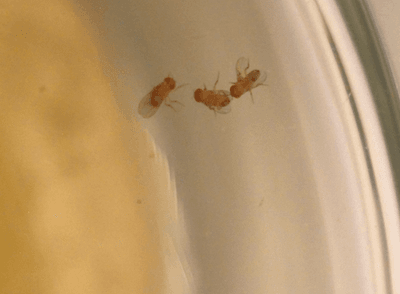


Male fruit flies of the Drosophila genus fight over mates and food when they encounter each other – with the exception of Drosophila santomea males, which court each other with mating songs instead. This unusual trait appears to be driven by a female desire to mate with their own species, creating a preference for distinctive behaviors that facilitate recognition.
A great deal of what we know about genetics and behavior in animals comes from the study of Drosophila melanogaster, one of the half-dozen or so model species that have dominated scientific research. Vital as these fruit flies have been for learning about nature and ourselves, it’s possible the somewhat arbitrary choice of D. melanogaster over other insects has subconsciously shaped the way we see the world.
D. melanogaster males are known to be aggressive to each other – researchers witness it every day – and Dr Youcef Ouadah works in a lab at California Institute of Technology that has spent decades studying the factors that control this aggression. For comparison, they decided to compare behavior with other Drosophila species. The team found little difference with closely related species, with one major exception in D. santomea.
Ouadah and colleagues isolated D. santomea males and then put two in a cage with a floor coated in apple juice. Instead of fighting, the males flapped their wings at each other in the way Drosophila do when courting females, creating a mating tone.
"All the conditions we've used to study aggression in other fruit fly species were the same, so we were expecting fighting, but these males behaved sexually toward one another," Ouadah said in a statement. "They courted one another all the livelong day, even though they were set up in the lab by us to fight." This, the team decided, had to be explained.
Arguably driven by heterosexist prejudices, biologists have long attributed male-male courting behavior in animals to an inability of horny males to distinguish members of their species by sex. However, the team realized something more interesting was going on. “The D. santomea males can distinguish males from females and reproduce at typical rates," Ouadah noted. "Things still work out for mating, but the males don't have to fight each other."
Fighting rivals comes at a serious cost, representing a major cause of mortality in some species, and uses up a lot of energy even if serious injuries are rare. However, these evolutionary drawbacks have not been sufficient to get other Drosophila species to abandon the practice, making the team wonder why D. santomea’s taken a different path.
As their name suggests, D. santomea are native to the island of São Tomé, Africa, but they don’t have it to themselves. Instead, their territory overlaps with D. yakuba, a generally lower-altitude species. Like horses and donkeys, D. santomea and D. yakuba produce offspring when they mate, but these are sterile – or at least for the fruit flies the males are.
From an evolutionary perspective, the goal is to have grandchildren. Lots of sterile children hinder that, so female D. santomea need a way to tell potential partners of their own species from those not worth their time.
The clue to how they do that came when the team identified three differences in pheromones between D. santomea and D. melanogaster. "We think D. santomea females evolved a sexual aversion to a pheromone [cVA] produced at high levels by males of the 'wrong' species, D. yakuba, which in turn forced males of the 'right' species to respond by reducing production of that same pheromone," Ouadah explained. "This pheromone also ordinarily prevents courtship among males, so without it, high levels of male SSB [Same Sex Behavior] appear."
Interestingly, downshifting cVA doesn’t just turn a fruit fly bi, it also makes him more attractive to other male Drosophila, even those from species with plenty of cVA.
“If you put two D. melanogaster together, they'll fight, and if you put two male D. simulans (another fruit fly species found across the globe) together, they'll fight. But if I put my D. santomea males in front of those other males, they all start courting my guys," Ouadah said. "So, this pheromonal mechanism reaches across species boundaries."
It’s like some conspiracy theorist’s nightmare about a woke agenda changing animals’ sexuality come to life.
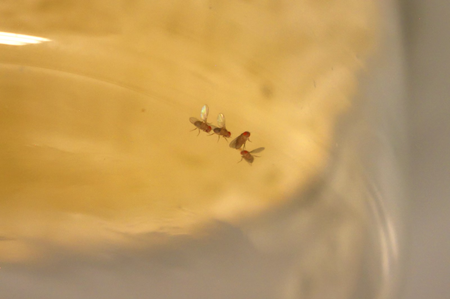
The pheromone and behavioral changes benefit the species and female D. santomea, but there has to be something in it for individual males, or it wouldn’t stick. The authors found the courting males are not establishing equal partnerships to share the food and a female in a harmonious throuple. Instead, they establish dominance through courting – presumably by one making his wings “sing” louder and longer. As a non-lethal method for deciding who takes precedence, it’s got considerable advantages over the alternatives.
"It's in the interests of both members of an interacting pair of males, evolutionarily, to avoid fighting and instead make a dominance relationship transparent and known to both flies through noninjurious means," Ouadah added.
If male-male courting is so beneficial you’d expect it to have emerged elsewhere, and indeed the team eventually found another fruit fly, D. persimilis, that does the same thing. D. persimilis and D. santomea share a love of high-altitude conditions, but are separated by 13,000 kilometers (8,000 miles) and 50 million years of evolution, so the approach evolved independently, rather than being from a common ancestor.
More speculatively, Ouadah noted, "Our closest living relatives, chimpanzees and bonobos, show similar patterns of historical cross-species mating. It is tempting to imagine that in many other similar cases, reproductive isolation was the driving force behind the emergence of high SSB levels that persist into the present, as seen in the case of bonobos."
Given that SSB in bonobos is at least as common among females as males, the explanation is probably not that simple. Indeed, the authors note that while SSB may turn out to be more frequent in species that have newly branched off from each other, there are many factors that may influence whether it persists or disappears as separation increases. Even in fruit flies cVA is not the whole story, as males of some low-cVA species still fight. A second pheromone, 7-T also appears important, but its role is less clear.
Therefore, stopping World War III is sadly not just a matter of lowering the cVA of those in power to turn them from fighters to lovers.
Ouadah is now exploring how the pheromone changes are reflected in specific neurons in the fruit fly brain. He’s already shown they can be made to attack each other by activating aggression neurons using light.
The study is published open access in Current Biology.


 1
1