Nature
 PUBLISHED


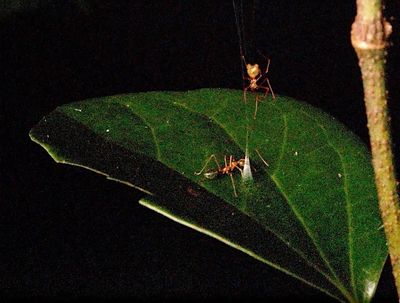


Predator-prey interactions have created some of the coolest strategies in the animal world. From mesmerizing cuttlefish, to head-popping mosquitoes, the world’s animals have come up with some pretty ingenious ways to get their dinner. For a new species of Australian ballista spider, this involves the construction of a smelly, spring-loaded lure to yeet their ant prey in the air, landing perfectly inside their web.
The spider is a new species, so doesn't have an official scientific name, but is thought to belong to the genus Propostira, which contains only two other species.
The team observed the spider building carefully constructed tension lines between leaves. When these lines were cut by the green tree ant, Oecophylla smaragdina, the force of their release would send the prey flying into the air.
“It’s very unusual for a spider to feed on ants, because they’re notoriously dangerous, and even more bizarre to find a spider that eats only one particular ant species,” said lead researcher Professor Ajay Narendra in a statement.
“Ants have a range of chemical defences – including the ability to sting in some species – and they use alarm signals to rapidly recruit hundreds and even thousands of other ants as backup to overcome potential predators.”
During the day the spider species rests on the underside of leaves above where the green ants forage. At night the spider then uses its silk to drop around 50 centimeters (19.7 inches) to lay an anchor on a lower leaf. The spider then turns into something of an engineer, creating between 15 and 60 silk lines that form a cone near the ground.
The ants react aggressively to this new structure in their space and bite down on the cone. Unfortunately for the ant, this is just what the spider had planned and the bite causes the anchor point to detach, launching the ant into the air at an acceleration of more than 1,300 meters per second squared.
“We suspect during the final construction stage the spider adds a pheromone that specifically lures worker ants and induces an aggressive attack, triggering the snare,” said Professor Narendra.
“This seems to be the only case where a spider’s web is designed to catch a single prey species, and where the mechanism is triggered by the prey rather than by the predator.”
Once the ant is ensnared in the web, the spider waits for it to become fully entangled before going to wrap it in silk.
The team compares the spider’s structure to that of a spring, which stores elastic energy within the tension of the silks. Interestingly, the ants themselves have large sticky pads on their feet; this means the spider’s trap has to overcome a force of more than 100 times the ant’s body weight caused by these pads, as well as the weight of the ant itself.
“The ballista spider’s snare is bioengineered to store elastic energy in the silk and rapidly release it, giving it incredible instantaneous power density – greater than any other specialised silk-based biological catapults,” said Professor Narendra.
“The ants it preys on have adhesive pads on their feet, so the contraction of the bundle of tension lines has to overcome a force of many times the ant’s body weight to lift it.”
Only the O. smaragdina ants were captured by the spider’s trap, even though the team released three other ant species near the web to see how they would interact. In each case they walked near to the cone but did not bite or interact with it.
To explain this the authors suggest that the spider could use pheromones to lure the O. smaragdina ants closer to the trap and induce the aggressive response.
The study is published in Current Biology.