Nature
 PUBLISHED


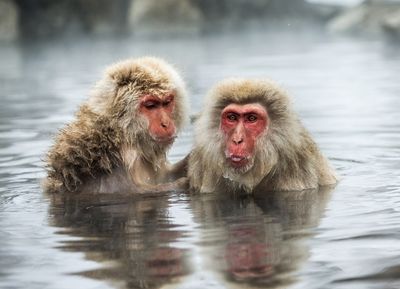


Data from 491 non-human primate species reveals reports of same-sex sexual behavior (SSB) in 59, and the distribution is not random. Although there are no doubt many cases where SSB happens without scientists reporting it, new research suggests its frequency reveals the conditions under which it represents an evolutionary advantage, like reinforcing social bonds in the face of environmental and social challenges.
Same-sex sexual activity has been documented widely in the animal kingdom with observations of thousands of species, from dolphins and lions to beetles and birds. Although many of these involve one-off encounters, there are also plenty of examples of long-term partnerships and parenting, such as between male penguins and "lesbian" seagulls.
In many, perhaps most, cases, the animals involved were not exclusively same-sex attracted. Indeed, some scientists argue that what we might anthropomorphize as bisexuality was the ancestral state in the animal kingdom, with exclusive attraction to one sex a later variant that may be rarer than we think. Whether that is true or not, SSB doesn’t appear to be equally common in all species and conditions, inspiring a quest to see whether genetics or environment account for the variation.
Imperial College London PhD student Chloe Coxshall and co-authors have tried to apply this question to non-human primates, and have identified a long list of factors that make an ape, monkey, or lemur more likely to be getting it on with members of its own sex. Purely environmental influences feature on the list, along with some that are probably hereditary, indicating that, not unexpectedly, the truth is bigger than binaries.
Species with complex and often hierarchical social systems, like baboons, are more likely to have reports of SSB, as are those that are long-lived, like chimps and bonobos, the authors found.
In addition, those at the highest risk of being eaten by predators, or that live in conditions where food is scarce, like Barbary macaques and vervet monkeys, are also more SSB-inclined.
Perhaps the most counterintuitive observation is that sexually dimorphic species (that is, where there is a big size difference between the sexes) show more SSB, such as mountain and lowland gorillas. That certainly rules out the possibility that some animals’ horniness overrides their ability to tell others apart by sex.
To those without a background in the field, this may come across as a very odd list, but the authors predicted each based on certain hypotheses. For example, if you expect to have a good time with members of your pack, both male and female, perhaps there is more incentive to keep an eye out for predators and warn everyone when you see them. Maybe there’s even a spotter’s reward.
Likewise, they proposed that in more hierarchical social structures, SSB could be a way everyone can sleep their way to the top (our words, not the researchers’). Longer life spans make lasting bonds more important, and SSB can help with that.
As Dr Isabelle Winder of Bangor University, who was not involved with this research, put it in an accompanying News and Views: “Living in a complex, long-lasting social group is potentially stressful and can incur noticeable energetic and reproductive costs. In these contexts, a flexible range of behaviors that supports the building and maintenance of strong interindividual relationships would be an advantage.” SSB may be part of that.
The authors even anticipated the connection to sexual dimorphism, noting that these species have more dominance-related conflicts (think male mountain gorillas fighting for a harem). Non-aggressive ways to keep things civil may be particularly important here.
Nevertheless, some of the authors’ hypotheses did not stand up. Smaller primates were not more likely to engage in SSB. Meanwhile, other factors proved important in only one sex. For example, colder conditions are associated with more SSB in males, but not in females.
The authors acknowledge the susceptibility of their work to other researchers’ observer bias. Only one peer-reviewed report exists of SSB in some of the included species, while others had only been observed getting it on in captivity, not in the wild. If scientists’ attention is not randomly distributed – for example, watching species with longer lives or more complex societies more closely – we might be more likely to have scientific records of SSB in these categories, irrespective of actual frequency.
To take this into account, the authors looked at data on how many hours researchers had spent watching their subjects in the papers they relied on. These certainly indicated some stark variations. On average, you have to watch common marmosets for more than 300 hours to see an incidence of SSB. Among Japanese macaques, on the other hand, SSB occurs 2.8 times an hour. It’s not clear if this is for each adult, or when watching a whole troop, but either way, it makes us wonder how they get anything else done.
The limited number of species for which there is useful data also means that a few examples that are really into SSB (notably bonobos and Japanese macaques) might be skewing the conclusions. Having said that, this new work also ups the number of non-human primate species from 51 to 59 in which SSB has been documented. When the authors reran the analysis using a subset of species that have been most extensively studied, some of their findings stood up, but others reversed, such as susceptibility to predation.
The authors note that some of their findings match those for comparisons between human societies, but caution against jumping to conclusions. “In humans, it may not be food scarcity or rigid social hierarchies that drive these patterns, but rather the pressures of modern social living. Is it possible that a link exists whether consequential, causal or correlational, perhaps mediated by mechanisms such as pleiotropy (in which shared genetic factors influence different traits)?” they write. “While entirely conjectural, our findings in non-human primates may provide a framework for future hypotheses on humans."
“We … stress that evolutionary hypotheses neither determine the validity of individual identities nor diminish their inherent value,” they also note.
However, “[A]s with all studies that are looking at animal behaviour, I would be incredibly uncomfortable speculating about how these then map on to human behaviours,” Josh Davis of the Natural History Museum in London, and author of A Little Gay Natural History, pointed out to The Guardian. “People are complex and a result of a whole range of different factors separate from other animals, making these comparisons and extrapolations incredibly contentious.”
The study is published in Nature Ecology & Evolution, as is Winder’s News & Views.