Humans
 PUBLISHED


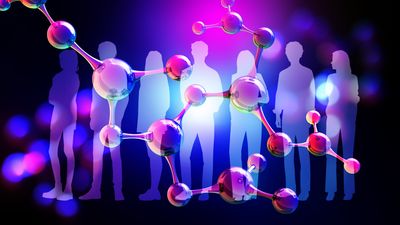


Humans smell, there’s no denying it, but are some of those smells sending out chemical signals we aren’t consciously aware of? Are we, like ants, giving off pheromones? We spoke to Dr Tristram Wyatt, Senior Research Fellow in the Department of Biology at the University of Oxford, who recently spoke at the IFRA UK Fragrance Forum 2024, to find out.
What are pheromones?
TW: Pheromones are smells. They're chemical signals between members of the same species, and they affect physiology and behaviour. So, it's sending a message between individuals. The word was invented in 1959 when the first pheromone was chemically identified, and it means transferred excitement.
How did we discover them?
TW: The first pheromone to be identified was that of the female silk moth, and her chemical signal causes the male silk moth to flap his wings excitedly and try to find her. That's what the scientist, the chemist [Adolf] Butenandt, used to track down the pheromone in his colourless solutions. He used traditional chemistry to try to locate the molecule, synthesize the molecule, and, having identified it, he then – crucially – went back to the male moths and asked them, had he got it right? Their excited wing fluttering told him that he had identified the molecule correctly.
That was really the beginning of modern pheromone research. Butenandt needed half a million female moths to get enough pheromone, because each moth produced a tiny, tiny quantity. It was lucky that it was a domesticated animal, the same silk moths we get our silk from, so he could get the female in large numbers.
Now, with gas chromatography, mass spectroscopy, and good chemistry, that same process can be done with one moth, instead of half a million. That is, if you know the kind of molecule you were looking for.
The other thing we have realised since then is that he didn't know it, but he was incredibly lucky. Had he chosen almost any other moth, he would have had a much more difficult problem, because the silk moth has a single molecule as its pheromone. Whether that's because of domestication, I don't know, but most other moths gain their species specificity – so, each moth species has its own pheromone blend – and the way they make them unique is by combining different molecules together in a particular combination or ratio.
The number of molecules can be anything up to six or so different pheromone molecules, often variations on a theme, but that would have meant that Butenandt would have taken years, even more years than he did take (which was a good decade), to identify the pheromone. It's much more complicated when you're trying to track down a combination of molecules.
Which animals have pheromones?
TW: It was very quickly realised that ants and other social insects are the supreme users of pheromones, whether we're talking about ant trails or alarm pheromones in bees.
There was quite a debate about pheromones in mammals because there was an initial idea that mammals were too complicated to use these simple chemical messages, but gradually people have come around to the idea. There is a spectacular pheromone very nicely identified in rabbits, which is produced by the mother and the baby rabbits. The pups use this pheromone to find a nipple when they're looking to suckle. So, that's a very important part of their life.
Why might we think humans have pheromones?
TW: Well, humans are mammals. Mammals are smelly, and so are we, and pheromones have been found not just in rabbits, but also in mice. We know less about what's happening in cats and dogs, but they certainly have pheromones.
It’s highly likely that humans have pheromones, and there is another clue, which is that our smells – the smells we give off as we grow up and go through puberty – change. As children, we don't smell very much, but as adults, we start to get these glands developing, particularly in our armpits and groins along with the hair that grows there.
If we were looking at any other mammal, we'd think these were probably something to do with reproduction, something to do with sex. So, although no pheromones have been identified so far in humans, I would be very surprised if we didn't discover that humans do have pheromones, just like other mammals.
Why has it been so tricky to prove?
TW: To identify a pheromone, you have to go through the steps that Butenandt did for the silk moth pheromone. You have to have a behaviour, you have to collect the molecules, you have to identify them, synthesize them, and then you have to close the loop by going back to the original study. In the case of Butenandt, it was his male silk moths and their wing fluttering that showed the molecule worked. That's the gold standard for identifying a pheromone. It needs large numbers of subjects. It needs rigor, and that has never been done for human pheromones.
How could we get there?
TW: I think what could happen is that we start from scratch. We start with human behaviours, and then begin doing more robust experiments. Eventually, we'll need to go to the chemists, but actually, there's a lot we need to do to show that smells really are important in those human behaviours. And it might not just be [about] sex, as I mentioned in the rabbits, pheromones are used for other things apart from sex.
Smell is very important to newborn babies. They may not open their eyes for a little while. So, smell is very important. This group in France have found, and this is only a preliminary study, but they’ve found that babies will turn to the secretion from little glands around the nipple of lactating mothers, mothers who are producing milk. They'll also turn to a glass rod that has the secretion deposited on it, no matter who the woman is.
So, it's not just responding to the smell of their mother. It's actually responding to something that seems to be produced by any lactating woman. That's very exciting, because one of the things about pheromones is they're not about recognizing a particular individual. They are, as it were, universal signals across the species.
This feature first appeared in Issue 31 of our digital magazine CURIOUS. Older issues of CURIOUS are free for all users. To access new issues, become an All Access Member.