


 Humans
 PUBLISHED

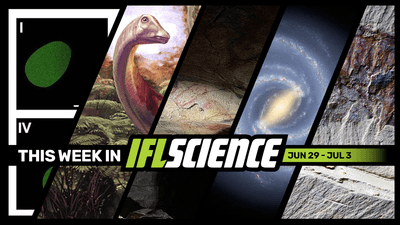


This week, the first-ever dinosaur fossil found in Antarctica belonged to the largest dinosaur species to walk on Earth, the Milky Way’s outer arms are 10 percent farther away than we previously thought, and a 518-million-year-old fossil is the earliest found evidence of spider fangs. Finally, we explore the totally new hallucinogenic compound that might be revealed in one mushroom.
Create an IFLScience account to get all the biggest science news delivered straight to your inbox every Wednesday and Saturday.
With "SpudCell", Scientists Have Made The Most Sophisticated Attempt At Creating An Artificial Lifeform Yet
“This is the most fascinating thing I think I ever got to work on,” Kate Adamala, one of the creators of the world's first synthetic cell, SpudCell, says. “We've built a cell that looks very similar to a natural cell – it has a membrane, it has the DNA inside it, has the cytoplasm. And it behaves very much like you would expect a natural cell to behave. The difference is that ours is fully chemically defined. And that means I have a blueprint of it. I have a full ingredient list.” Read the full story here
First Dinosaur Fossil Ever Found In Antarctica Is From A Titanosaur, The Largest Dinosaurs To Walk On Earth
A fossil first discovered in 1985 has now been scientifically described as that of a dinosaur. This makes it the first-ever dinosaur fossil found in Antarctica, and it's likely that the fossil belonged to a member of the largest dinosaurs ever to walk the Earth: the titanosaurs. Read the full story here
"We Got Very Excited": Ancient Human DNA Recovered From Cave Art For The First Time
Throughout the caves of Europe, in flickering torchlight, ancient people painted the most extraordinary scenes of cave lions, mammoths, and bison. We might finally be able to know the artists. A new study reveals the first ever human DNA recovered from art on a cave wall. Read the full story here
The Milky Way's Outer Arms Are 10 Percent Farther Away Than We Thought, So Our Galaxy Just Grew A Bit
It is difficult to estimate the size and structure of our galaxy. The problem is that we are in it, hence we don't have any full pictures of it. It has taken years for ESA’s Gaia to create the best map of the Milky Way, confirming, for example, that the Milky Way has four and not two spiral arms. The distance to the outer arms, however, still had quite a large uncertainty, and new research places them farther out than expected. Read the full story here
How Did Spiders Get Their Bite? 518-Million-Year-Old Funky Fossil Is Earliest Evidence Yet Of Spider Fangs
How did spiders get their fangs? Spiders are one of the most successful groups, surviving in pretty much every habitat. One of the reasons for their success could be the evolution of powerful mouthparts known as chelicerae, which are used as pincers or fangs to manipulate and kill prey. Read the full story here
TWIS is published weekly on our Linkedin page, join us there for even more content.
Feature of the week:
"It Sounds So Impossible": The Mushroom That Makes You See Tiny People Might Reveal A Totally New Hallucinogenic Compound
Psychedelics may play an increasingly promising role in future healthcare practices, but there is one mushroom whose magic is so bizarre that it may usher in even more discoveries to come. It has a strange and unique characteristic: people who eat it hallucinate tiny people for days after they’ve consumed it. This peculiar trait is remarkable enough, but the story gets even weirder when you take into account the fact that this mushroom lacks any known psychedelic compound. Read the full story here
More content:
Have you seen our e-magazine, CURIOUS? Issue 48, July 2026, is available now. This month, we asked, “What Is Archaeoastronomy?” – check it out for exclusive interviews, book excerpts, long reads, and more.
PLUS, the We Have Questions podcast – an audio version of our coveted CURIOUS e-magazine column – continues. In episode 22, we ask, “Where Is The Human Heart Located?”
The Big Questions podcast is back for season 6! In episode 2, we ask “Could AI Find A Cure For Cancer?” Host Laura Simmons speaks to Professor Florian Markowetz, Professor of Computational Oncology at the University of Cambridge and Senior Group Leader at the Cancer Research UK Cambridge Institute, to ask what may be one of the biggest questions of all.
Our Break It Down podcast now has a new monthly format, coming at you in both audio and visual. So tune in each month to hear about some of the wildest science stories and adventures we’ve been on. Kick off this month with “Artemis II Records, Neanderthal Not-Hybrids, And Introducing ‘Moon Joy’”

 2
2