Space and Physics
 PUBLISHED


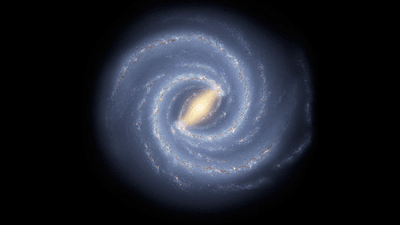


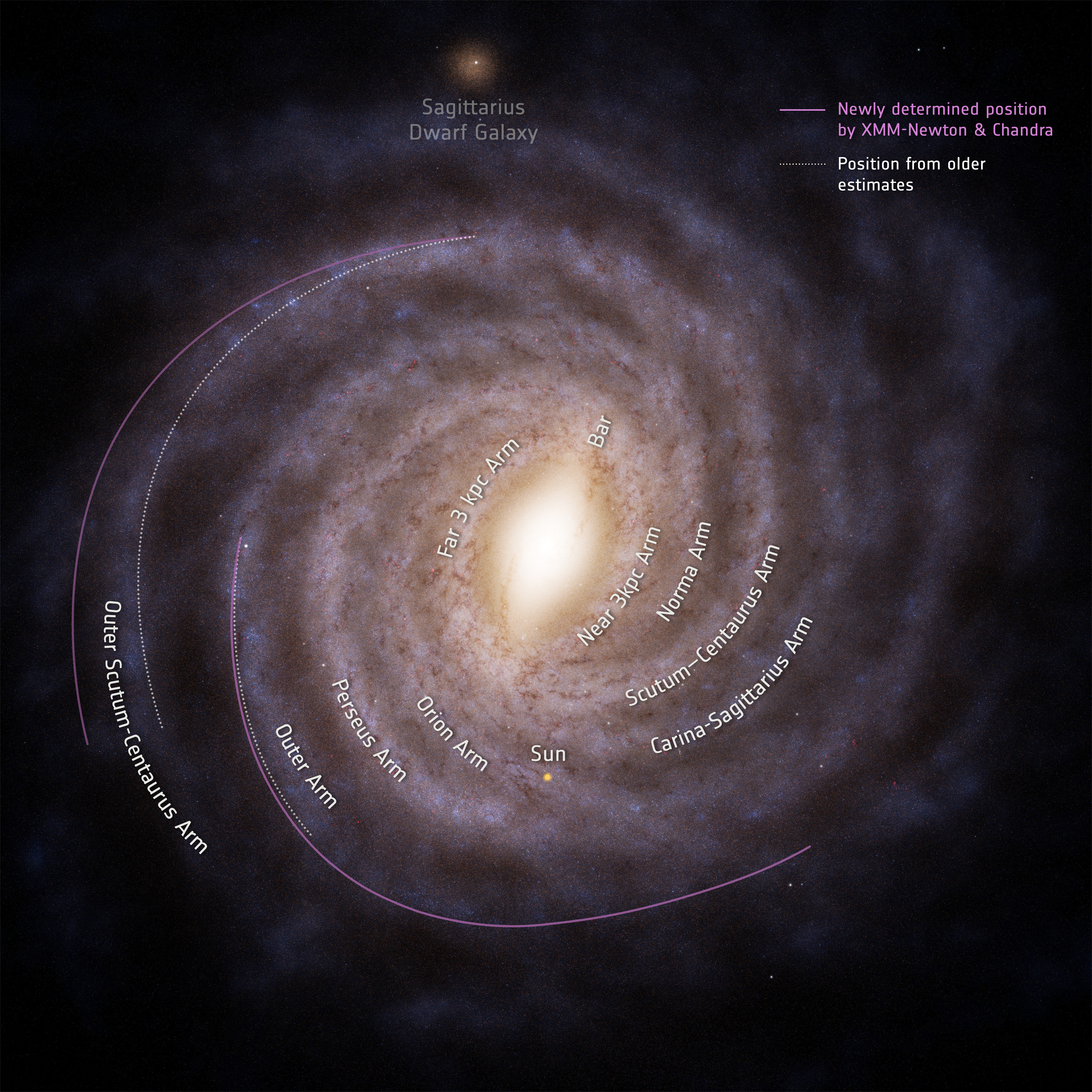
It is difficult to estimate the size and structure of our galaxy. The problem is that we are in it, hence we don't have any full pictures of it. It has taken years for ESA’s Gaia to create the best map of the Milky Way, confirming, for example, that the Milky Way has four and not two spiral arms. The distance to the outer arms, however, still had quite a large uncertainty, and new research places them farther out than expected.
To perform this fascinating measurement, researchers used the most powerful explosions in the universe: gamma-ray bursts. These huge releases of energy following supernova explosions did not happen in our own Milky Way but in much more distant galaxies.
These events also released X-ray light, which can become scattered by the dust grains that exist in the spiral arms of our galaxy. Using ESA’s XMM-Newton and NASA’s Chandra, the team found concentric rings of scattered emissions, and with those, they could make a distant measurement. They discovered the two outer arms are a bit farther away than we thought.
The team was able to confirm the distance between our own arm, named the Orion Arm, and the next one out, the Perseus Arm.
The observations also provided measurements to the next two arms going away from the center. The Outer Arm and the Outer Scutum-Centaurus Arm both lie up to 10 percent further away than previously thought. The Outer Scutum-Centaurus Arm lies 62,000 light-years from Earth.
“We usually model the Milky Way's outer arms indirectly based on what we know of how our galaxy rotates, but doing it this way leaves room for error," Beatrice Vaia of Istituto Nazionale di Astrofisica (INAF), Italy, who led the research as part of her PhD, said in a statement.
“Instead, we did something new: we looked at the aftermath of three cosmic explosions that took place in far more distant galaxies. These explosions flung out X-rays that echoed through several of the Milky Way’s outer arms – and we measured the distances to these echoes directly.”
Both XMM-Newton and Chandra are veteran space observatories that have been keeping an eye on the high-energy universe. Their ability to see in X-rays, where many energetic events peak, has been revolutionary for our understanding of black holes, stellar explosions, and more. Turns out they can also help us map the galaxy
“This finding is a great example of how ESA’s longer-standing missions – such as XMM-Newton, which launched in 1999 – still have a hugely important role to play in exploring the Universe,” sid Erik Kuulkers, ESA XMM-Newton project scientist.
The study is published in the journal Astronomy & Astrophysics.