Technology
 PUBLISHED




Lightning flashes. Thunder rolls. A shadowy scientist laughs maniacally. On the table: his experiment – a success that flies directly in the face of god and nature. “It’s alive,” he cries at the sky. “It’s alive!”
Well, okay – maybe that’s a bit of an overstatement. We have no idea what the weather was like on the day Kate Adamala, Aaron Engelhart, and their colleagues first created SpudCell, the microscopic new entity that’s making headlines worldwide this week.
Adamala has no illusions about having “usurped any divine privilege,” she tells IFLScience. And, certainly, they never shouted about it being alive: “I wouldn't say it's living at all,” Engelhart says.
But as for the sheer significance of the breakthrough – well, that seems to be the real deal.
SpudCell: the cell fully made in a lab
Despite the name, SpudCell has nothing to do with potatoes. It’s more of a joke that stuck, says Adamala: “I'm Polish,” she tells IFLScience. “I'm made of potatoes.”
The official story, though, “is that we want to invoke Sputnik,” Adamala explains. As the first artificial satellite in space, Sputnik “enabled the space age,” she says. “With the SpudCell, we're enabling the age of biology.”
I think we will look back and mark this moment.
Elizabeth Strychalski
If not a tuber, though, what is it, exactly? Well, it’s a cell, the fundamental building block of living organisms. It eats; it grows; it reproduces; it responds to its environment; it even kind of undergoes evolution. And it is, start to end, entirely human-made.
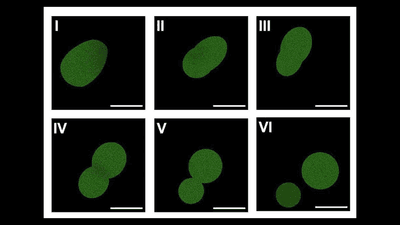
“This is the most fascinating thing I think I ever got to work on,” Adamala says. “We've built a cell that looks very similar to a natural cell – it has a membrane, it has the DNA inside it, has the cytoplasm. And it behaves very much like you would expect a natural cell to behave. The difference is that ours is fully chemically defined. And that means I have a blueprint of it. I have a full ingredient list.”
For all that SpudCell resembles a natural cell, it’s fundamentally artificial. Life is spectacularly messy, generally speaking: our genome – all 3 billion base pairs of it – is stuffed with junk DNA; gene redundancies abound; time and again, evolution has made a misstep whose correction now stands glaringly obvious in our genetics.
SpudCell, in contrast, has just 90,000 base pairs in its genome, each chosen with efficiency and effectiveness in mind.
“It definitely was on purpose,” Engelhart says. “We're getting all these components to work together and do the cell-like stuff, but every one of those comes at some operational cost.”
Take one of the stand-out features of SpudCell, for example: the fact that it replicates itself. But the longer your genome, the harder it is to replicate, Engelhart points out – making minimalism not just an aesthetic choice or a quirk of the process, but a crucial ingredient.
Even then, SpudCell isn’t perfect. It can only replicate for about five generations, and it does so at a rate far slower than many other cells. Like viruses, it can’t make its own ribosomes – the particles that make proteins, which are present in all living cells. It doesn’t really even do anything, other than sit there and occasionally spit out a daughter cell.
And yet, it’s unquestionably an exciting breakthrough. “Honestly, this feels different,” says Elizabeth Strychalski, a cellular engineer at the National Institute of Standards and Technology (NIST) who was not directly involved in the study.
“This study is the result of a long arc of scientific inquiry and technology development, so it can feel inevitable. But, none of that should detract from just how impressive and utterly paradigm shifting this will be to biotechnology.”
“I think we will look back and mark this moment,” Strychalski tells IFLScience.
The logic of SpudCell
To be clear, SpudCell isn’t the first synthetic cell ever created. That was the “semipermeable microcapsules” of Thomas Chang, brought into existence all the way back in 1957.
Neither is it the first time cells have been controlled by artificially constructed genomes – that was achieved in 2010 by Craig Venter and his team, and has been occasionally repeated in the years since.
But none of those earlier experiments went quite as far as SpudCell. “What we've done is taken a lot of chemical processes and gotten them to kind of work [together] to do a lot of the same things that living cells do,” Engelhart explains. “And that's kind of a first step towards this long-term goal of sort of actually booting up a synthetic cell.”
It’s a proof-of-concept roughly 10 years in the making for Adamala and her team, and it’s a step towards the answers to questions fundamental to our understanding of life itself.
“We won't be able to fully understand cells – understand life – unless we're able to fully chemically define it,” Adamala says. “And that's one of the guiding, driving forces of science: to understand where we come from, how does life work, how does matter become life, basically.”
It's possible to imagine a future where all those chemicals that we need for civilization can be made with biology.
Kate Adamala
But there are less philosophical applications to the research, too – synthesizing drugs, making new materials, and detoxifying other substances.
“These new synthetic cells will fill a key gap in our capabilities for studying engineered biological systems that span from chemistry to biology,” says Strychalski. “NIST is poised to provide the measurements that will be needed to understand these synthetic cells and use them safely for applications that matter to improve people’s lives.”
But to hear Adamala tell it, SpudCell is nothing less than the first step towards saving the world.
“Our kids are not going to have a planet to live on unless we do something right now,” she says. “Like, the climate's already running out of control, and global inequality is increasing – and the root of a lot those problems is in oil, in petrochemicals, in the petrochemical industry that concentrates the production, the chemical industry, and the use of oil that changes the climate.”
There are two main responses to the climate crisis, she argues: revert back to pre-industrial levels of fossil fuel usage – “I'm not interested in that,” Adamala says. “I like my lifestyle. I like everything that this technological civilization gives me. And I'm not alone in saying that” – or invent our way out of it. SpudCell, she says, is the latter option.
“It's possible to imagine a future where all those chemicals that we need for civilization can be made with biology,” she tells IFLScience. “And that has […] giant benefits. One is that it's carbon neutral, so you don't have the climate impact. Maybe even eventually we would be able to reverse some of the changes we've already made.”
This is the kind of vision we’re already skirting around the edges of – but currently, the only tools we have, even in potentia, are “really, really toxic,” Adamala explains. “And that's been making it very difficult to engineer natural bacteria that can make some of those small molecules that we need to make all the products we need. And that's where we come in.”
“We say, instead of trying to engineer natural biology, which is a black box […] let’s instead make our own biology from scratch that we fully understand and then we can engineer.”
It’s a dream that Adamala admits is decades away – but with time, SpudCell may evolve into something genuinely world-changing. And the good news is, Adamala and her colleagues only want to spread the word.
“We started a non-profit, called Biotic, that is going to fund and coordinate research globally for people who want to develop [SpudCell],” Adamala says. “I cannot do it myself, and I cannot build like a small collaboration within few labs that can do it – we need a global community working on it.”
“It has to remain in the public domain,” she adds. “It has to be open source technology.”
Not life, but something like it
As exciting as it is to hear that scientists have created life from nothing, SpudCell is just a first step – and while it’s a significant one, it’s not especially large. “[SpudCell] is certainly not alive,” points out Engelhart, “and it's certainly not to the point where it's working anywhere nearly as robustly as, you know, the bacteria that do it without trying every single day.”
But what it lacks in vigor, it more than makes up for in potential. Could SpudCell lead to entirely synthetic life? What would that look like? What would it tell us? Will it really save the world? These are questions we can, for now, only speculate on.
We have been looking to the stars for another example of what life can look like, but now we can build that here.
Elizabeth Strychalski
“I think that it can be difficult to feel the full weight of history being made when you are living it,” Strychalski tells IFLScience. “We all woke up this morning, and I’ll bet that for most people – myself included – the world felt pretty much the same as the day before. Except the world is not at all the same, because we now have a new kind of cell that for the first time since the beginning of life on earth didn’t come from other living cells.”
“We have been looking to the stars for another example of what life can look like, but now we can build that here,” she says. “This will allow us to learn new things about biology, build new ways of making our lives better with biotechnology, and tell new stories about what it means to be human.”
The study, which is a preprint and has not yet been peer reviewed, has been posted to the Biotic website.