Technology
 PUBLISHED
 1
1



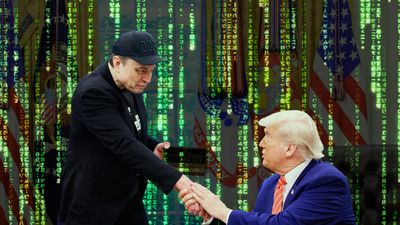


Nick Bostrom, the philosopher behind the "simulation argument", has said in an interview that people like Elon Musk and President Donald Trump should have more reason to suspect that they (and we) are all living inside a simulation.
Since The Matrix and the rapid improvement of computers, a significant number of people have become interested in the simulation hypothesis. This is the idea that our reality is a simulation being run on some advanced computer, either by an unknowable alien species, or even by our own species in what we think is our far future.
Though not taken entirely seriously, with natural explanations for our existence favored by most scientists, the idea has had a certain amount of academic investigation. But while it may be impossible to test whether we are in such a simulation (though one scientist – Melvin Vopson – thinks that information having mass would be a big clue), that won't stop the philosophers.
In 2003, Nick Bostrom wrote a particularly influential paper on the topic, titled Are you living in a computer simulation?. In this work he did not attempt to argue that we are inside a simulation, but that one of three things must be true.
The first of these is that humanity will go extinct before we are even in a place where we can run such simulations. Secondly, humanity will be able to create them, but lose interest in running simulations (for example, simulating their ancestors) and will therefore not produce them in significant numbers. Or, finally, we are all living inside a computer simulation right now.
In the paper, he argued that if humanity does survive to become "post-human", and doesn't for whatever reason lose interest in simulating our ancestors, then they would be capable of running so many simulations that the vast majority of all observers would be simulated, rather than original humans.
Therefore, if it looks like humanity won't go extinct you should increase your belief in the idea that our reality is a simulation.
Again, this was not an attempt to argue in favor of the idea that we are in a simulation, or say that all three options are equally likely. Bostrom has so far avoided answering whether we are in a simulation, instead seeing it probabilistically.
If, for example, we began to create very realistic simulations ourselves, this should significantly increase your belief that we are in a simulation. But if instead we find ourselves on the brink of a nuclear war, maybe we should give that "humanity will go extinct" option another look.
Honestly, though, you shouldn't spend too much time worrying about whether we are in a simulation or not, maybe with the obvious exception of Neo. But one problem, discussed by Bostrom in a new interview with Max Raskin, is that you should also update your belief depending on what sort of life you find yourself living.
For example, in the interview Bostrom was asked whether he has updated his beliefs, given how "everything lined up really well" for him in terms of his career. He suggested that yes, you should update your beliefs if you happen to be someone particularly prominent in society.
"I think to some degree it increases the credence somebody should assign to the simulation hypothesis if they are in a slot that would be more likely to be disproportionately frequently simulated. I don't think it's a huge effect relative to what everybody has reason to believe," Bostrom told Max Raskin.
"You could take some even more extreme case, perhaps, if you were Donald Trump or Elon Musk. If you’re reflecting, you got to at some point wonder what are the chances that I would just happen to be Donald Trump or Elon Musk."
Musk, of course, already believes that it is overwhelmingly likely we're living inside a simulation, though he attributes this belief to the advance of video games, rather than him finding himself living the life of Elon Musk. According to the SpaceX CEO, at the rate of computational progress, games where whole realities are simulated are inevitable.
“Those games could be played on any set-top box or on a PC or whatever, and there would probably be billions of such computers or set-top boxes," he said in 2016. "It would seem to follow that the odds that we're in base reality is one in billions.”
Donald Trump, despite offering up a number of opinions on a vast array of tangential topics, has not (yet) spoken about the simulation hypothesis.
Of course, the scenario where you update your credence based on who you happen to be only applies if we are living in a certain kind of simulation where not everybody is simulated. If you happen to think you are one of these people, whose circumstances are so bizarre or interesting that it would make sense that your world is simulated, we still shouldn't worry too much about it.
Bostrom, who could be described in this way, told Raskin that he believes in his gut that Raskin, for example, is a real person who was really sitting there in front of him.
"And in fact, even if this is a simulation, I still think that you and I are real in the sense that matters — that we would be having real experiences, our actions would matter, and so on," he added. "It's just that the nature of what that reality consists in would have the surprising property of being implemented in some computer built by an advanced civilization."
In short, try not to think about it too much. Just enjoy the world around you as best as you possibly can. And even if we are simulated, it's not like we can escape or anything.