Technology
 PUBLISHED




Californium-252 is a very strange radioactive isotope. It doesn't occur naturally on Earth, it furiously spits out neutrons, and it's notoriously expensive to produce.
Outside of Russia, virtually all known stocks of californium-252 (Cf-252) come from one place – Oak Ridge National Laboratory in Tennessee — and researchers there have just announced a new way to produce it.
What is Cf-252?
Cf-252 is very useful as it undergoes spontaneous fission, meaning it continuously emits vast numbers of free neutrons (nearly 140 million neutrons are emitted from a single microgram of the isotope every minute). This makes it a powerful neutron source that can kick-start nuclear reactors with minimal provocation.
It’s also important for “national security applications” and has several industrial uses, like searching for contamination in coal and the exploration of oil wells.
Typically, Oak Ridge National Laboratory will make batches of Cf-252 every two years using a complex, multi-stage process.
Without boring you with the details, it essentially involves bombarding curium (a highly radioactive, synthetic metal named after Marie Curie) with neutrons in a reactor until it transmutes into californium.
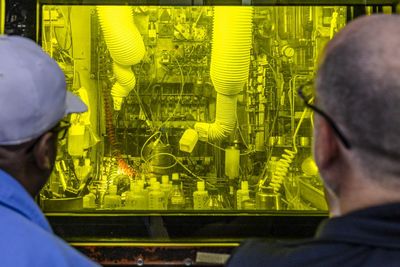
The irradiated targets are then moved, still blisteringly hot, to a heavily shielded facility where technicians dissolve them and use acid to chemically strip out the Cf-252 from other bits of unwanted radioactive junk, like americium, curium, and cerium.
That last step used to take about two weeks because the solution must become less acidic before separation chemistry could begin.
A new way to make Cf-252
In a new method, radiochemist Lætitia Delmau fine-tuned that old approach with one using a neutral solvent. This allows technicians to separate the Cf-252 straight out of the very acidic solution, with much less waiting.
It produced the exact same result as the previous method, but cut separation time by about a week. That might sound small, but it’s a significant saving in a process this costly to run.
“One hour inside the specialized nuclear facility where we produce Cf-252 is extremely expensive,” Delmau said in a statement.
“If you can save time, it saves you a lot of money,” she noted.
“This is an exciting new chapter in Cf‑252 production. We’re raising the bar internally while pushing the boundaries of heavy‑element production," added Samantha Schrell, Cf-252 Program Manager at Oak Ridge National Laboratory.
It’s estimated that Oak Ridge National Laboratory makes less than one gram of Cf-252 each year, but a single gram is reportedly worth up to $25.6 million, making it one of the most valuable substances on the planet.
It's a costly process to make it, requiring a huge amount of fancy equipment and specialist expertise, plus there's high demand and small supplies.
Demand is rising
But this breakthrough comes at a particularly convenient time. Demand for Cf-252 is on the rise as the US kickstarts a major legislative and financial crusade to boost its nuclear capabilities.
Led by the Trump Administration, this push aims to see the construction of new large reactors alongside the rollout of small, experimental modular reactors.
Part of the motivation is powering the surge in energy demand from AI data centers, but it's also about securing a domestic power source that can't be disrupted by foreign markets, geopolitical upsets, or hostile actors in an increasingly uncertain world.
Cf-252 could play a key role in all this, and now, it's become a little bit easier to get our hands on.