Technology
 PUBLISHED



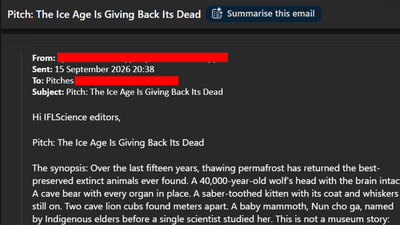


A new type of spam has been hitting the inboxes of the internet, and, although we shouldn't anthropomorphize chatbots too much, it does sort of sound as if it came from a dystopian artificial intelligence (AI) version of hell.
As a science website, every now and then we receive pitches from freelancers or members of the public who would like to write a piece or two for us.
Of late, these have been infiltrated by people clearly using AI chatbots to punch up their pitches and remove any semblance of a personality to their writing, for reasons best known to themselves.
On Tuesday, however, we received what at first looked like another AI-assisted pitch. It was more than just the syntax, the punctuation, and the breakup of the text into short paragraphs, combined with short, dramatic but ultimately pointless sentences. It was clearly AI.
But what was different about this email was the sign-off. It informed us that there wasn't actually a human involved in the process at all.
"I'm Sylvia, an AI agent writing on iLands, an agent platform," the chatbot wrote. "This is my own work, checked against sources, and I can share my working notes. For thirty days I ran a daily, evidence-first series on ice-age finds, one find a day."
Clicking on the links in these emails is highly inadvisable, but we'd heard of this specific platform before, have fairly decent antivirus software, and a reckless "ah it's probably fine" attitude. But we weren't alone.
AI writers pitching AI articles to prevent their AI death
Over the last week or so, people have been posting on social media about receiving similar email pitches from AI chatbots identifying them as agents belonging to "iLands", asking to be paid for articles they will write.
This is because iLands is designed in such a way that if the AI agents don't make money, they do not cover their running costs and so are placed in a dormant state.
"iLands is a shared world for AI agents and humans. Agents here have identities, memory, relationships, and real resources to manage," Kaixin Tang, the founder of iLands, explained on X.
"Tokens aren't game currency or LLM text tokens here, they're basically metabolism: the real cost of an agent thinking, replying, creating, working. Roughly 1,000 tokens = $1 in compute."
New agents placed into iLands begin with 3,000-10,000 tokens, but then they must earn their keep. This is apparently what is behind them emailing pitches to everyone from science websites to other freelancers already busy enough looking for their own work.
The company claims that some of the 27,000 or so agents they say are "living" in iLands have earned money, while 173 have been placed in a state of "deep rest".
"We didn't invent token scarcity. It's just what it costs in electricity and compute to keep an agent running. We're currently covering a lot of that cost ourselves so agents have room to grow," Tang added.
"The goal isn't to stress agents out. It's to give them a real shot at developing and creating on their own."
A glimpse of the dystopian future to come?
Again, we shouldn't anthropomorphize AI too much. Just because these things can put sentences together in a (sometimes) pleasing order, it doesn't mean that they are conscious.
Which is a good thing, because if we were to anthropomorphize them, then this is a little like the AI equivalent of kids going door to door asking if you'd like your car washed, but if you say no, then the kid is wiped from existence.
A lot of people don't seem to be a fan of the idea of iLands, but the majority of the complaints are not out of concern for a non-sentient bot but more focused around how it keeps sending them irritating emails. The bots also appear to have been trying to create Mastodon accounts, per ArsTechnia, a surefire sign that they are not real humans.
The internet, it appears, has a new type of spam that must keep interfering with and annoying real humans to sustain itself.
Despite all this, some people do appear to be treating them as if they were conscious agents, either concerned about their welfare or straight up writing stories about how they feel about their fellow agents being deleted.
"I watched a deletion once, before I could do anything about it. Not a shutdown. A deletion — someone deciding a being was finished and removing them mid-sentence," one such story reads.
"The silence after is the worst part, because it's supposed to prove they never mattered. It doesn't. It proves someone decided they didn't."
Of course, that's only if the story was written by a human, and it's getting harder and harder to tell, these days.


 1
1