Nature
 PUBLISHED
 2
2


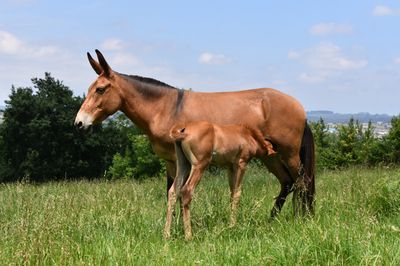


Horses may not technically be humanity’s best friend, but they’re not far off. They help us work and travel; they’re surprisingly good seeing-eye pets; they’re great at conning early 20th century Germans and, in a pinch, they apparently make a tasty snack. Donkeys, too, have long been our close companions, and for many of the same reasons – and while they may be smaller and slower, they’re hardier and stronger, gentler and calmer, and maybe even smarter than their larger cousins.
It wasn’t long, therefore, before somebody thought of trying to combine the two species. And it worked! By 1000 BCE, not even a millennium after the two species’ ranges had crossed, people in Anatolia, modern-day Türkiye, were crossbreeding male donkeys with mares to create an animal with the best qualities of both: the mule.
“With their long ears and sturdy bodies, [mules] combine the strength of a horse with the resilience and robustness of a donkey,” writes The Brooke Hospital for Animals. “They have what veterinary scientists call ‘hybrid vigour’, and with a more diverse genetic makeup comes certain strengths.”
For example, mules “live longer than horses and tend to require less food than a similar-sized horse,” they note. “They can also sense danger better and are more cautious than horses or donkeys, making them safer to ride when crossing difficult terrain. A mule’s skin is less sensitive than a horse or donkey’s skin, and is more resistant to Sun and rain.”
Thanks to this jack-ass-of-all-trades nature, mules have found themselves employed in any number of roles throughout history. They’re useful on farms, like donkeys, but they can pull racing chariots like horses; even as late as the 20th century, they were deployed in war, and they’re still vital helpers for things like delivering resources to remote areas or visiting the Grand Canyon. It totally makes sense that as soon as this awesome animal was created, people would want to keep breeding them.
There’s just one problem: mules can’t reproduce. In fact, in the past 500 years, only about 60 have ever been known to give birth.
The mane tail
Given their parentage, it’s sort of surprising that mules can exist at all. Donkeys and horses may both be equine animals, but they’re different species: “donkeys and horses evolved from a common ancestor, Dinohippus, who roamed the plains of North America some 10 million years ago,” explained Ben Hart, Equine Behaviourist and the Senior Lead in Behaviour and Human Behaviour Change at The Donkey Sanctuary, in an article for BBC Discover Wildlife last year. “Since then, they have evolved into very different animals.”
“As a result of this long evolution, donkeys are closer ancestors to zebras than they are to horses,” he wrote.
Pairing up a donkey and a horse and expecting them to reproduce, then, is sort of like trying to create some kind of humanzee hybrid (which doesn’t work, don’t ask how we know). The two species simply don’t – or at least, shouldn’t – have the right genetic equipment to make a baby: “their chromosomes don't match up well,” explained Monica Rodriguez, then a grad student in Stanford University’s Department of Genetics, back in 2007.
It's not just a case of mom having blue eyes and dad’s being brown – horses and donkeys don’t even have the same number of chromosomes as each other. “A horse has 64 chromosomes and a donkey has 62,” Rodriguez pointed out. “A mule inherits 32 horse chromosomes from mom and 31 donkey chromosomes from dad, for a total of 63 chromosomes.”
It’s a marvel they manage to make it work at all – but luckily, the two sets of chromosomes are just similar enough, and just benign enough to pull through without any of the pesky or fatal disorders that so often plague other species when extra DNA turns up. “Having an odd number of chromosomes doesn't matter for everyday life,” Rodriguez explained. “A mule's cells can divide and make new cells just fine […] nothing on the extra or missing chromosome causes it any harm.”
In fact, there’s really only one aspect of life they can’t take part in: reproduction.
Why mules can’t breed
So, here you are: a mule zygote, busily matching up your horse and donkey chromosomes into pairs, and wondering what to do with the lonely bonus one from mum. You figure out a way to sort them out well enough – a few lopsided couplets don’t seem to be a problem – and you get to cloning yourself.
It’s all working fine – until you start trying to make gametes. These, the ova or sperm cells, are created via a slightly different process: meiosis. And for that, the mule’s genetic mismatch is a big problem.
Why? Well, usually, when two parents make a baby, the two sets of chromosomes will match up together very well. Your mum’s chromosome 1, for example – the largest of the bunch – will match up with the similarly sized and similarly encoded chromosome 1 from your dad, and so on for each other set. That’s not true for mules – stick a pin in that.
Now, when it’s time to form your sex cells, your chromosomes basically go through a blending process. It’s like if you have two very similar puzzles, and you swap some pieces over to make two new ones of the same size and shape – because your mum and dad had the same type of chromosomes, they can do that without problems.
With a mule, however, it’s different. The puzzles have a different number of pieces; the pieces are different sizes and shapes; one’s a circle and the other is square. You can try to swap pieces over, and maybe one time in a million it’ll work – but mostly, it’s just going to create a mess.
Add it all together, “and you have a real problem,” Rodriguez said. “The chromosomes can't find their partners and this causes the sperm and eggs not to get made.”
And no sperm or egg means no baby mules. Case closed.
Almost.
Defying the odds
So: mules can’t breed. It’s true; it’s been known since time immemorial. It’s such a truism that the Ancient Roman equivalent of “when pigs fly” – that is, something that could never happen – was cum mula peperit: when a mule has a foal.
Except, every so often, mules do have foals. It’s very rare – only a few dozen documented cases in almost 500 years, and most of those unverified by science – but it does happen, even if it seemingly shouldn’t. “It disproves Mendel’s law of independent assortment,” argued Roger Valentine Short, a reproductive biology researcher at the University of Melbourne in Australia, in 2007.
Despite his protests, though, he couldn’t deny what he was looking at: a foal that had been born to a mule. Genetic tests proved the mother was a mule, they proved the baby was hers – as unlikely as it was, it had to be possible, because it had happened.
“This could make the front cover of Science,” Short said.
Other mule foals have been met with similar – and justified – disbelief. “There is something like less than one chance in 10 billion that this kind of thing could occur by chance if the chromosomes in the mother behave randomly,” said Oliver Ryder, then a geneticist at the Center for the Reproduction of Endangered Species at the San Diego Zoo, after the 1984 birth of mule foal Blue Moon. That case proved to be especially baffling: genetic testing revealed no evidence the baby had any genetic markers from the father at all. “No recombinations took place,” Ryder later reported. “There was no reassortment.”
“We looked at markers on every chromosome,” he said. “This was an extremely unexpected finding.”
Unexpected is right: that’s the sort of thing amphibians do, but not mammals. It’s certainly enough to make scientists take a second look at these supposedly “sterile” mule mares, that’s for sure – though not the males. Those are always infertile.
At least, y’know. So far.