Nature
 PUBLISHED


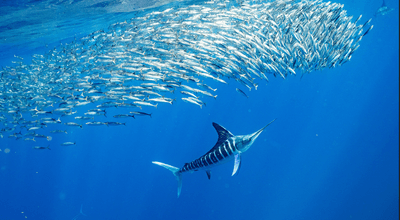


Billfish – saltwater predators armed with prominent pointy bills – are typically considered to be the fastest swimmers in the oceans. The speediest species of all are thought to be the sailfish (Istiophorus). They do have stiff competition though; the bluefin tuna is a serious threat to their throne.
Sailfish are beautifully adapted for swimming at breakneck speeds to hunt prey. Growing up to 3 meters (10 feet) from tail to bill, they are a member of the marlin (Istiophoridae) family that features an impressively large dorsal fin that resembles the sail of a boat.
Two species of sailfish make up the Istiophorus genus: Atlantic sailfish (I. albicans) and Indo-Pacific sailfish (I. platypterus). You can probably guess where those two live.
While sailfish are likely to be some of the fastest-swimming marine animals, recent research has suggested they might not be as nippy as once thought.
In the 1940s, scientists estimated that sailfish could achieve speeds of up to 30 meters a second – that’s a rocketing 108 kilometers per hour (67 miles per hour).
However, a study in 2015 suggested this speed is likely to be overblown. They estimated that sailfish do not exceed swimming speeds of 10 meters a second, or 36 kilometers per hour (22 miles per hour).
It’s highly unlikely that sailfish can maintain this speed for a prolonged period. These top speeds are likely achieved in short but intense bursts of movement while hunting prey. Most of the time, large predatory fish like this tend to cruise at a speed comparable to the average human stroll.
_-_Kawahara_Keiga_-_1823_-_1829_-_Siebold_Collection_-_new_version.jpeg "An illustration of the Indo-Pacific sailfish (Istiophoridae platypterus).")
A 2015 project by the Central American Billfish Association recorded a tracked sailfish (I. platypterus) accelerating at a G-force of 1.79 G, according to the Large Pelagics Research Center at the University of Massachusetts. If the fish maintained that speed for just a couple of seconds, they said it would be the equivalent of 125.5 kilometers per hour (78 miles per hour).
Bluefin tuna might trump this, though. The Large Pelagics Research Center carried out a similar study on bluefin tuna and found they can accelerate at 3.27 G, which is 1.8 times the sailfish record.
Once again, however, these are just bursts of speed and it’s unclear how long the fish maintain this activity (they might not even have maintained this acceleration for 2 seconds, as the researchers assumed).
On land, speed records are a bit clearer. The undisputed champion of running on land in the cheetah, the sleek big cat of Africa adorned in solid black spots.
The cheetah’s top speed is often cited as 112 kilometers per hour (70 miles per hour), although that speed was recorded decades ago and is likely to be inaccurate. In 2012, a cheetah called Sarah was recorded at Cincinnati Zoo running at a top speed of 98 kilometers per hour (61 miles per hour), earning herself the world record.