


 Nature
 PUBLISHED


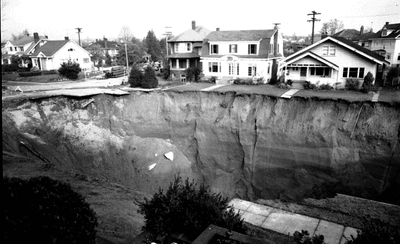


A large hole in the ground appearing literally overnight may not be the most devastating natural disaster, but it’s certainly eye-catching and therefore news-worthy. When a sinkhole beneath a Shropshire canal sent two narrowboats plunging into a crater just before Christmas last year, IFLScience received a request for an explainer on why this happens.
Swallowing boats may be a rare feature for sinkholes, but they’d been in the news a lot in 2025. The month before the canalboat disaster, a 10-meter (30-foot) wide sinkhole appeared outside a California School that was being used as a polling place at the time. Last September, a sinkhole in Bangkok caused an enormous road collapse and traffic disruption near the city center, with a major roadway expected to be closed for a year. Nearby buildings were left teetering on the edge of sliding in.
The timing of the request proved appropriate. The following week, legislation was introduced into the US Congress to map sinkholes across America and investigate their causes. Then the new year was marked by a sinkhole appearing in a well-used football field on the other side of the world.
The congressional bill reflects the fact that sinkholes are expensive, even when there is no loss of life. Just this week, the cost of fixing a sinkhole from 2022 in Baltimore was revealed to be more than $30 million, almost three times earlier estimates. “It got worse and worse and worse,” Baltimore public works director Matthew Garbark said. “And we kept adding [money] to it.” Maybe that’s where we got the idea of a great big hole someone tips money into. Being able to predict them beforehand would be highly beneficial, even aside from the cases where they can be fatal, such as the sleeping man who disappeared into a sinkhole and has never been seen again.
What Causes Sinkholes?
If the causes of sinkholes were simple and well-understood, it’s unlikely anyone would be proposing a program to, as the bill’s summary puts it: “Study the short-term and long-term mechanisms that cause sinkholes, including extreme storm events, prolonged droughts causing shifts in water management practices, aquifer depletion, and other major changes in water use.”
Nevertheless, there is plenty we already know.
Sinkholes are most common in areas with carbonate rocks (mostly limestone and dolomite), which can be dissolved by slightly acidic water. Other soluble substances, such as salt and gypsum, are rarer but can produce the same effect.
Sandstones can also produce sinkholes. Although primarily composed of minerals like quartz, which are not soluble in water, the sand particles are small and held together by a natural cement. When the cement is carbonate, water may dissolve it. If that water is flowing, it can carry the sand grains left behind away.
Even without anything getting dissolved, water flowing underground can carry loose soil or sand away, creating a similar, although often smaller, void. Old mines, or even animal burrows, sometimes make spaces large enough to be dangerous on their own, or in combination with water’s activity.
The most dramatic cases, such as those described above, occur when rocks are dissolved beneath the surface, but a top layer is initially unaffected, for example, when non-soluble materials cover limestone. To people on the surface, all appears to be well, until quite suddenly the void beneath becomes large enough that the upper layer collapses, falling dramatically into the space below. That fall may be triggered by an earthquake, something heavy moving, or the covering layer falling under its own weight.
The more rigid the surface layer, the longer it will hold out, and therefore the larger and more damaging the collapse when it finally occurs.
The product can be less than a meter wide and deep, like the remarkably symbolic hole that appeared at the White House during Trump’s first term, or so deepthat the World Trade Centre could fit inside.
Are Sinkholes Getting More Common, And If So, Why?
Sinkholes can certainly be a natural phenomenon. Giant examples such as China’s “heavenly pit” or those near Mount Gambier date back hundreds of thousands or millions of years. Just this week, the case was made for the existence of sinkholes on Mars formed by similar processes, and that certainly isn’t our rovers’ fault.
So there is no reason to assume every new sinkhole has a human cause. Nevertheless, our activities are often responsible, or at least the most likely candidates, where the culprit is unconfirmed.
This year’s Australian sinkhole appeared close to drilling for a major road project, and the disruption that is causing is suspected of being behind it.
A common way sinkholes are triggered is for underground pipes to burst or even slowly leak. The influx of water will accelerate the dissolving of materials. Processes that redirect water flow can have similar effects, although they might also prevent a sinkhole somewhere else.
Cities are now particularly prone to dramatic collapses. As hard sources like roads and roofs replace plants that absorb rainfall, the water needs to go somewhere, and not all of it is captured by stormwater drains, creating more opportunities for erosion. Meanwhile, those same hard surfaces provide the perfect example of a rigid surface that will initially hold up as the space blow is hollowed out, and then break dramatically, quite likely when a car drives over it.
Too little groundwater can also be a problem, where it was helping support material above. The same overuse of Iran’s aquifers that is creating pressure to relocate Tehran is making larger areas vulnerable to sinkholes.
As with pretty much everything else, climate change is making the problem worse.
Consequently, it would be astonishing if sinkholes are not becoming more frequent, as well as being increasingly likely to occur in crowded cities.
Seismic testing can sometimes identify sinkholes before they appear, allowing the cavity to be filled or supports installed. However, Dr Francois Guillard of the University of Sydney told the ABC this is currently hard to do unless you already have a good idea where to look.



 1
1