Nature
 PUBLISHED


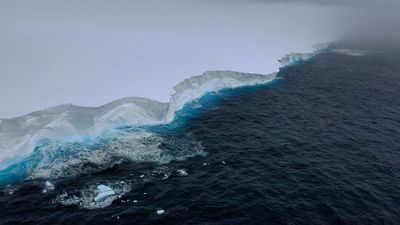


The world’s biggest iceberg – the A23a megaburg – has recently been spotted performing a full 360° spin as it floats off the coast of Antarctica.
A23a made headlines in November last year when the British Antarctic Survey (BAS) announced it was on the move for the first time in over three decades. The iceberg is currently making its way out of the Weddell Sea and heading down “Iceberg Alley”, a route that many icebergs take after departing from mainland Antarctica.
This week, the BAS has shared imagery of the A23a megaburg doing a 360° spin to the tune of “Spinning Around” by Aussie pop legend Kylie Minogue.
The imagery was captured between the end of December 2023 to February 2024 by MODIS (Moderate Resolution Imaging Spectroradiometer), an instrument aboard the NASA satellites Terra and Aqua.
You almost can’t tell from its agile twirling, but A23a is an absolute beast of an iceberg. With a height of 400 meters (1,312 feet) and covering an area of 4,000 square kilometers (1,500 square miles), the floating chunk of ice is larger than the state of Rhode Island.
The BAS has been keeping a close eye on the travels of A23a. In December 2023, scientists aboard the RRS Sir David Attenborough collected samples of seawater around the A23a to see how its movement impacts life in the polar region.
“We know that these giant icebergs can provide nutrients to the waters they pass through, creating thriving ecosystems in otherwise less productive areas. What we don’t know is what difference particular icebergs, their scale, and their origins can make to that process,” Laura Taylor, a biogeochemist at the BAS and the University of Cambridge working on the RRS Sir David Attenborough, said in a statement.
“We took samples of ocean surface waters behind, immediately adjacent to, and ahead of the iceberg’s route. They should help us determine what life could form around A23a, and how this iceberg and others like it impact carbon in the ocean and its balance with the atmosphere."
A23a was born in August 1986 when it was calved from the Antarctic coastline before almost immediately becoming grounded, tethered to the muddy seafloor for 40 years.
It briefly lost its title as the world’s largest iceberg in May 2021 when A76 detached from the Ronne Ice Shelf in the Weddell Sea. This single berg initially measured 4,320 square kilometers (1,667 square miles), but it later fragmented into three pieces.
Even A23a is relatively small compared to the biggest iceberg of all time. This colossus was spotted in November 1956. Since this was before satellite imagery, its exact size isn’t known, but it was estimated to be 335 kilometers long and 97 kilometers wide (208 by 60 miles) with an area of 31,000 square kilometers (12,000 square miles) – that’s three times larger than Hawai'i’s Big Island.