Nature
 PUBLISHED


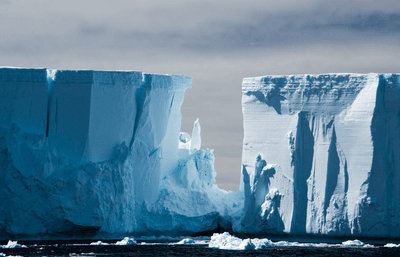


The world’s biggest iceberg – larger than the state of Rhode Island – is on the move for the first time in over three decades.
Measuring 4,000 square kilometers (1,500 square miles) and some 400 meters (1,312 feet) thick, the city-sized iceberg A23a was created in August 1986 when it was calved from the Antarctic coastline. The floating ice chunk quickly became ground in the muddy seafloor and stayed put in the Weddell Sea.
Now, satellite images have shown it has moved significantly over the past few years, according to the British Antarctic Survey.
Like most icebergs of the Weddell Sea, it’s expected that A23a will drift along with the Antarctic Circumpolar Current and eventually end up in the South Atlantic Ocean, BBC News reports. Eventually, like all icebergs, it will melt away to nothing.
The reason for the iceberg’s sudden voyage is yet to be understood.
"I asked a couple of colleagues about this, wondering if there was any possible change in shelf water temperatures that might have provoked it, but the consensus is the time had just come," Dr Andrew Fleming, a remote sensing expert from the British Antarctic Survey, told the BBC.
"It was grounded since 1986 but eventually it was going to decrease (in size) sufficiently to lose grip and start moving. I spotted first movement back in 2020," added Fleming.
The word iceberg stems from the Dutch word “ijsberg”, which means ice mountain. Generally speaking, icebergs that form in Antarctica are larger and flat-topped in shape, while those in the Arctic that calve from Greenland are smaller and often irregularly shaped.
About 90 percent of an iceberg's mass is typically below the water's surface, hence the expression "tip of the iceberg" used to describe a situation where only a small, visible part of a much larger problem is apparent.
A23a briefly lost its title as the world’s largest iceberg in May 2021 when A76 detached from the Ronne Ice Shelf in the Weddell Sea. This initially measured 4,320 square kilometers (1,667 square miles), but it later fragmented into three pieces.
Even A23a is relatively small compared to the biggest iceberg of all time. This colossus was spotted in November 1956. As this was before satellite imagery, its exact size isn’t known, but it was estimated to be 335 kilometers long and 97 kilometers wide (208 by 60 miles) with an area of 31,000 square kilometers (12,000 square miles) – that’s three times larger than Hawai'i’s Big Island.