Nature
 PUBLISHED
 3
3


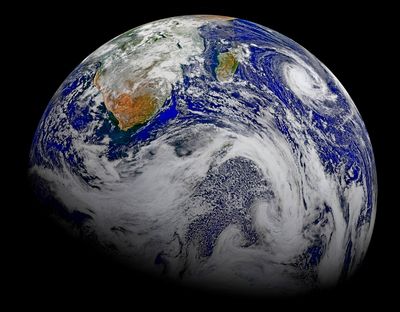


Scientists have discovered a previously overlooked line of symmetry that splits the Earth into Eastern and Western hemispheres. Each of these hemispheres appears to reflect the same amount of sunlight back into space, potentially playing a major role in the planet’s climate.
Atmospheric scientists have long known that the Northern and Southern Hemispheres reflect pretty much the same amount of sunlight into space. This puzzling fact is known as hemispheric albedo symmetry and occurs despite the hemispheres having different landmasses and weather patterns. The exact mechanistic explanation for how the north-south symmetry achieves this balance remains a mystery for scientists, though they suspect that cloudier skies in the Southern Hemisphere compensate for the expansive land masses and human-made aerosols in the North.
But while exploring whether the Earth may harbor other overlooked axes of balance, Jianhao Zhang at the National Oceanic and Atmospheric Administration in the US and colleagues discovered another line of symmetry. This line runs along the 27° East and 153° West meridians, through Europe, Turkey and Africa and Alaska, dividing the planet into halves that reflect pretty much the same amount of sunlight.
Zhang and colleagues made this discovery using 25 years of continuous data collected between 2001 and 2025 from NASA’s CERES satellites. The data relates to the amount of solar energy that is reflected into space. Climate is controlled by how much sunlight is either absorbed by the Earth or sent back out of the atmosphere. The total of this balance is known as the Earth’s Radiation Budget (ERB); when it is at equilibrium, the planet’s average temperature remains stable, but when it is imbalanced, climate change and global warming occur.
Using this date, the team established different categories for the albedo, including how much sunlight was reflected by ice-free oceans and how much was reflected by landmasses. They then tested these categories against climate models before digitally slicing the planet into different sections by latitude to explore how light reflected at different points.
It was here that they discovered the new Eastern and Western Hemispheres based on their near equal amounts of reflection. These two halves have nearly the same amount of ice-free water, similar cloud cover, and the nearly equal amounts of solar radiation being reflected by cloud-free skies.
At first Zhang was skeptical about the discovery; after all, the planet is basically a sphere, so if you slice it up, you can easily find two equal halves. But this skepticism was short-lived.
“What convinced me – and ultimately the scientific community – that this East-West symmetry is profoundly non-trivial comes down to three key features: its uniqueness, its persistence, and what we have termed its 'triple symmetry,'" Zhang wrote in a commentary blog post hosted by Nature.
This triple symmetry relates to it, firstly, being unique. It is the only line where this balance occurs in the East-West direction. Secondly, the symmetry is persistent, as it doesn’t vary across the globe across time – it has remained anchored to 27°E since 2001, when the data was first collected. Thirdly, and most importantly, the planet’s two halves have almost identical coverage of ice-free ocean and land, allowing the clear-sky and cloudy-sky components to effectively balance on another perfectly.
Zhang and his team believe the mechanism driving this balance is the El Niño–Southern Oscillation (ENSO).
“When we looked at the slight year-to-year wobbles in the exact longitude of this symmetry, we found a statistically robust correlation with the ENSO record. Our working hypothesis is that the Walker circulation – the large-scale atmospheric overturning circulation that links cloud systems across the tropical Pacific and beyond – acts as a massive planetary adjustment mechanism," Zhang wrote.
“During La Niña years, the Eastern Hemisphere reflects slightly more sunlight; during El Niño, the Western Hemisphere takes the lead. The back-and-forth shifting of the Walker circulation reorganizes cloudiness and reflected sunlight, essentially tethering the long-term symmetry to 27°E.”
Far from being a nice piece of trivia, this discovery has significant implications for climate science. The East-West symmetry offers scientists a new way to check existing and future climate models. An accurate model should not only reproduce the total reflected sunlight at 27°E but also reproduce the cloud-sky components and the ocean fraction underlying it. So, this new symmetry offers a way to “sanity check” models.
In addition, the new results caution against climate interventions such as solar geoengineering. The East-West symmetry further demonstrates just how complex and deeply connected the Earth’s climate is. If we fiddle with the Earth’s radiation budget, we risk altering the balance for the worst.
The study is published in Nature.