Nature
 PUBLISHED


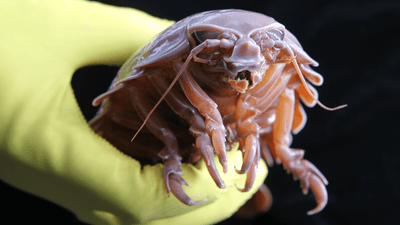


The largest isopods on Earth can be found deep below the sea. Scuttling around at depths where life and food are scarce, they exhibit many adaptations that make it possible for them to survive in such an inhospitable environment. Turns out, that includes not eating for upwards of five years.
Being a supergiant on the seabed is something of a paradox because at such depths – some upwards of 2,000 meters (6,562 feet) – there is very little to eat. It takes a lot of energy to get so big, so how do they do it?
To find out, a team of scientists at the Institute of Oceanology of the Chinese Academy of Sciences (IOCAS) used a combination of multi-omics analyses and functional assays. The multi-omics approach looks at an animal’s genes, proteins, and metabolic processes to get an idea of the biological mechanisms at work.
The results were then combined with functional assays – a kind of experiment that directly measured how the isopods' bodies function – to test whether the adaptations identified in the multi-omics data were actually helping the animals survive. Together, they revealed one of the supergiant isopods’ secret powers: a giant stomach.
Yes, supergiant isopods have enormous stomachs. Taking up about two-thirds of their body, they are significantly larger in ratio to body size compared to other isopods in shallow-water or intertidal habitats. Such a big size means that on the rare occasion food does arrive on the seabed – in the form of a sunken carcass such as a dead whale – the isopods can feast to bursting point. Then, it becomes a long-term energy store.
The food is broken down into a mud-like gloop that has a relatively low abundance of digestive bacteria like Firmicutes. Instead, it’s rich in Chlamydiae – no, not just an STD but actually a large group of bacteria of which some are associated with lipid metabolism and storage. And as you can imagine, a big store of fats comes in handy when you only get to eat every few years.
Once the isopods have had their fill and transformed their food into an energy store, they wind back their metabolism to lower the energetic cost of being alive. The researchers were able to replicate this effect by isolating a horizontally transferred gene, ND1 (something they borrowed from a symbiotic bacterium), and introducing it to zebrafish, nematodes, and human cells.
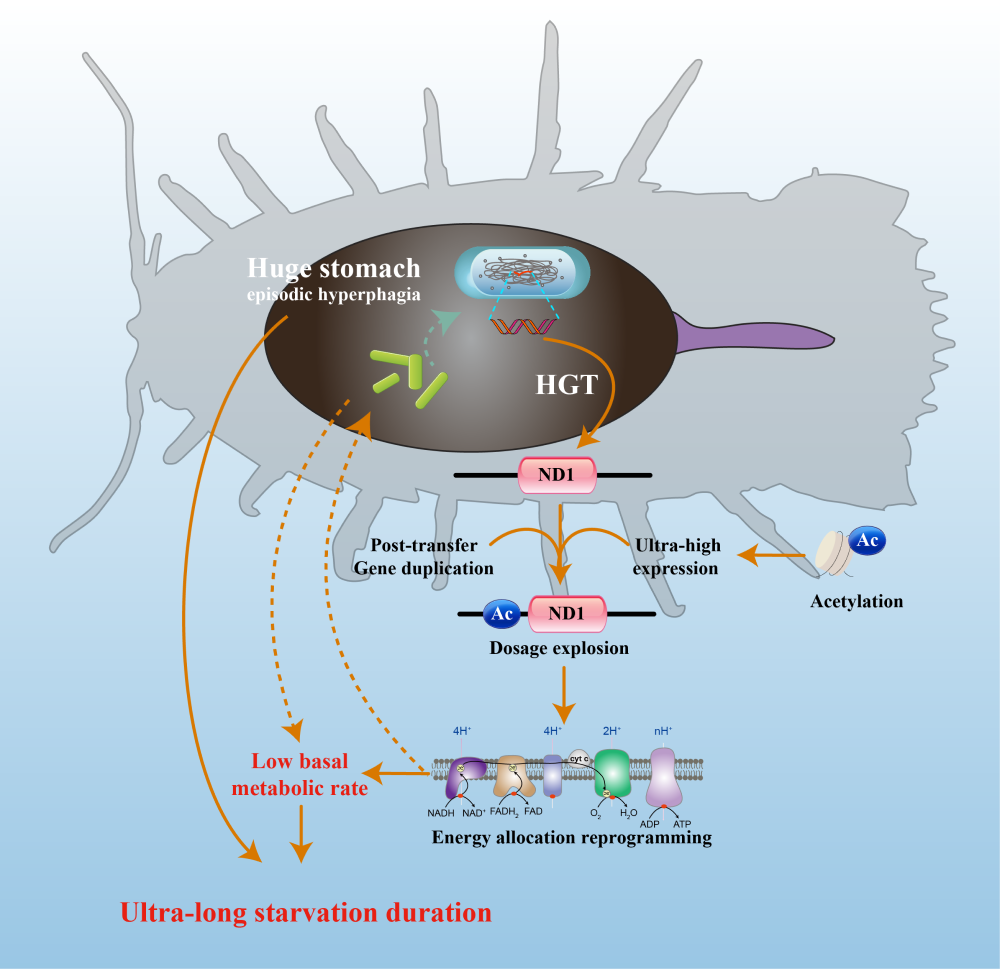
At average temperatures ND1 actually increased metabolism, making organisms less tolerant to starvation. However, once the temperature was lowered to mirror that in which the supergiant isopods live, its suppressive effect kicked in, lowering metabolism and mitochondrial activity. For the zebrafish, this increased starvation tolerance by 37 percent.
"Our work not only deciphers the mystery of ultra-long starvation tolerance in deep-sea isopods, but also provides an important paradigm for understanding how life balances growth and survival in extreme environments," said YUAN Jianbo, first author of the study, in a statement.
So, while supergiant isopods might spend upwards of five years without eating, when the time comes to feast, they really know how to party.
The study is published in the journal Cell.