Nature
 PUBLISHED




What you’ll discover in this article
- Australia is home to the world’s first tropical lamprey species.
- Although most lampreys are parasitic as adults, some feed on algae and bacteria all their lives, yet curiously retain the lethal-looking teeth of their ancestors.
- Dr Luke Carpenter-Bundhoo told IFLScience, “We may have caught them mid-evolution with their pants down.”
The discovery of the Australian brook lamprey on the world’s largest sand island is sending researchers on a quest to learn more about the presence of lampreys in Queensland, and the evolution of their bewildering lifestyle.
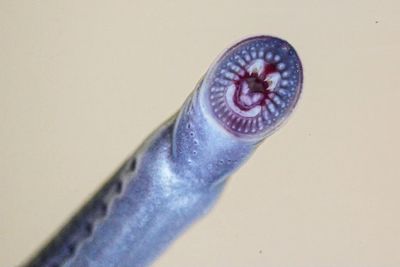
What might loosely be called lampreys’ faces look like something a horror film director dreamed up on a bad acid trip. While the rest of the vertebrate community decided these new-fangled things called jaws were pretty useful, lampreys decided they didn’t need them, and almost 500 million years later, it’s hard to argue with success. The lack of jaws doesn’t mean a lack of teeth, though, which most lampreys use to latch onto fish in freshwater downstream of where their larvae live, and then in the open ocean.
Some lampreys, however, live their entire lives in rivers and creeks feeding on algae, making those terrifying teeth seem rather superfluous. The incongruity of their looks and lifestyle has earned these lamprey species the nickname “vegan Draculas”.
Out of place
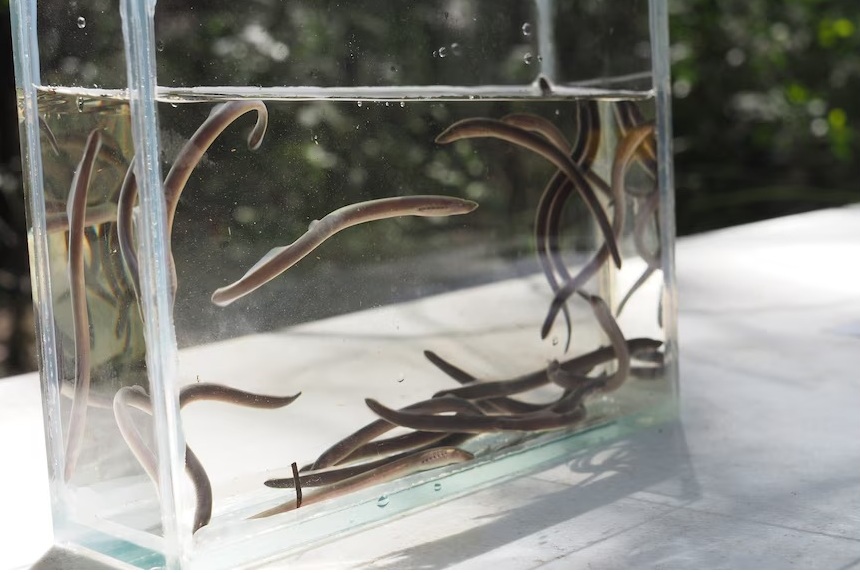
Dr Luke Carpenter-Bundhoo of Griffith University was studying the effects of Australia’s devastating Black Summer 2019-20 fires on the ecosystem of K’gari, the World Heritage-listed largest sand island in the world, formerly known as Fraser Island. He found a seven-gilled creature that resembled an eel, explaining in a statement, “I knew that what we had found were lampreys, and my immediate thought was ‘what are they doing here?’”
The fish was eventually identified as an Australian brook lamprey (Mordacia praecox), previously found in much cooler waters at least 1,400 kilometers (870 miles) south. Moreover, “This species was thought to be extinct in its original range, and now Queensland may be the only place it exists,” Dr Carpenter-Bundhoo said. “This might be the last bastion of this endangered species.”
Technically, Queensland is home to the world’s first tropical lamprey.
Dr Luke Carpenter-Bundhoo
Carpenter-Bundhoo told IFLScience vegan lampreys are extremely cryptic species, spending their entire lives in the sand on the bottom of freshwater streams. That means there may be a lot of them that we don’t know about, but also that the species are highly isolated and could be unable to colonize new territory if something happens to their homes.
They only live in places with sandy substrates, which K’gari is certainly rich in, and they have other quite specific requirements, like needing water colored with the run-off of tea trees.
The discovery set off a quest to find other lampreys in Queensland waters, and five populations have been found, representing at least three species.
“It was always thought they couldn’t exist in warmer waters, but they’ve been here and as far north as Rockhampton for more than a decade,” Carpenter-Bundhoo told IFLScience. “Technically, Queensland is home to the world’s first tropical lamprey.”
Clearly, there was a lot we were missing, and Carpenter-Bundhoo is on a quest to fill the gaps.
What’s with the teeth?
Ichthyologists are interested in seeing if there are new species among the finds, as Carpenter-Bundhoo suspects, and ecologists are excited by evidence that non-parasitic lampreys on other continents noticeably reduce rivers’ E coli counts. Others, however, may mostly want to know what’s going on with the teeth. Why look like a carnivore from hell if your diet can’t swim away?
“The teeth are vestigial,” Carpenter-Bundhoo told IFLScience. “Like an appendix.”
Teeth take a lot of energy to make, however, which suggests either the non-parasitic lampreys evolved too recently for selection pressure to have removed them, or they do perform some useful role unrelated to feeding.
Carpenter-Bundhoo admitted this is something we don’t know, but raised an even more intriguing possibility. “Every species of non-parasitic lamprey has parasitic species pair they resemble,” he told IFLScience. The conventional explanation is that the vegan lifestyle is one that keeps evolving through convergent evolution, with each non-parasitic species descending from its parasitic counterpart.
However, one might expect that those where the split is more ancient would have started losing their teeth by now. Carpenter-Bundhoo told IFLScience that some scientists think there is still gene flow between these species. After all, the parasitic lampreys spend much of their lives in the same waters as their friendlier counterparts, with a similar diet, until they metamorphose into ruthless blood-suckers. Perhaps they sometimes mate.
“There’s some debate as to whether they are even different species,” Carpenter-Bundhoo added to IFLScience. Instead, one species may simply have two very different ways of getting its nutrients, with some unknown environmental factor determining which path an individual takes.
“We may have caught them mid-evolution with their pants down,” Carpenter-Bundhoo said, although personally these are not the vampires we’d like to think of unclothed. “Humans love patterns and these don’t fit the pattern,” he added, leaving everyone unsure what box to put non-compliant lampreys in.
All this contrasts with the other way of looking at lampreys: as creatures that have been around for 485 million years, and whose fossils have barely changed in 145 million years. “They’re even more of a dinosaur fish than our Australian lungfish,” Carpenter-Bundhoo said.
That’s another reason to research them. “Studying lamprey DNA is a bit like looking back at an earlier edition of the vertebrate instruction manual, before hundreds of millions of years of evolutionary tinkering,” Carpenter-Bundhoo said. “Understanding them can help us understand more complex organisms, including humans.”
That project is urgent, given the changes their habitat is experiencing. “We can’t protect what we don’t know about,” Carpenter-Bundhoo told IFLScience. “These are such small, fragmented populations; it doesn’t take much to wipe out a species. There is a big risk of ‘silent extinction’. It has to have a name to protect for us to save them.”